
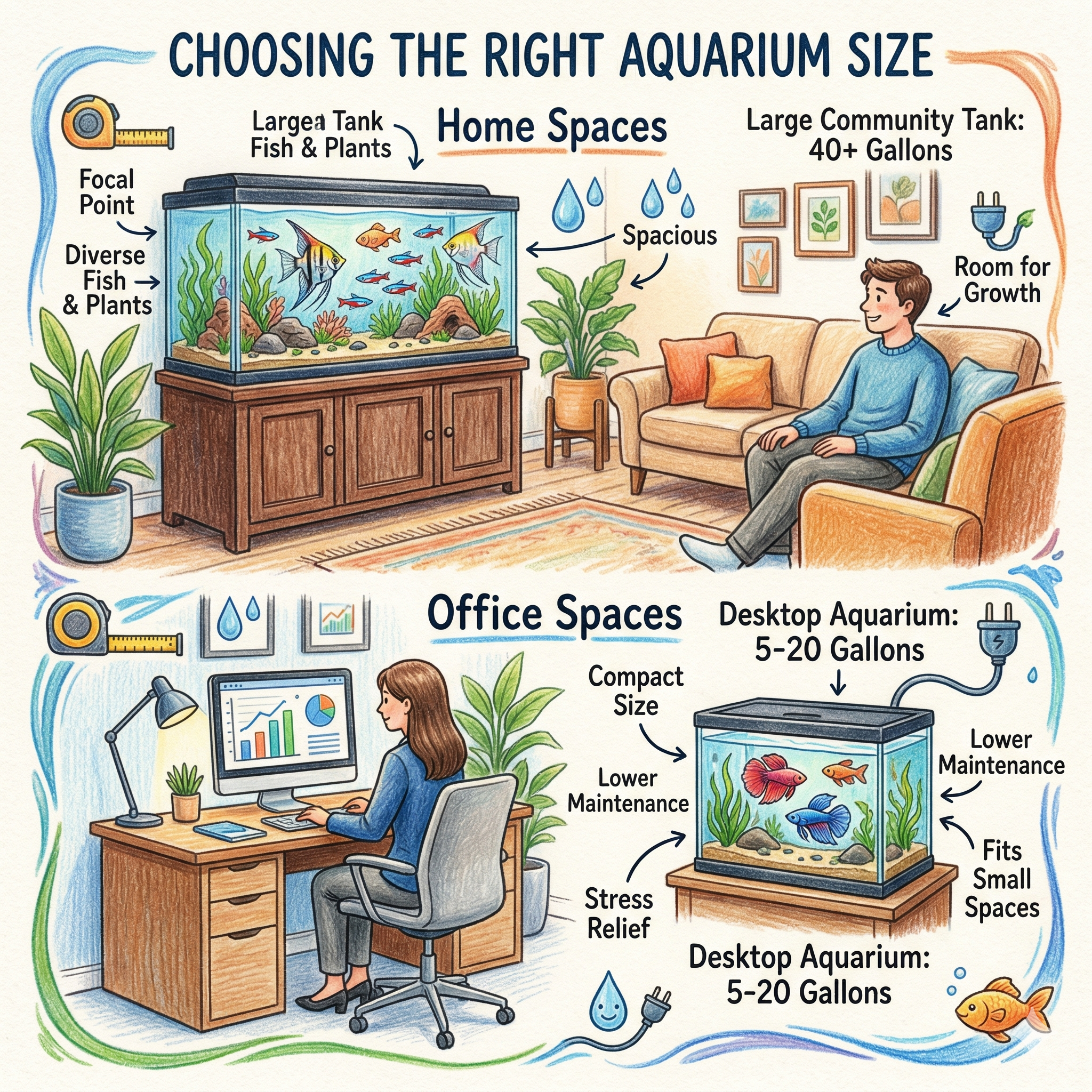
Choosing the Right Aquarium for Your Home or Office
One of the most important aquarium decisions happens before you buy a single fish.
In my own journey starting tanks in a small Oklahoma home, I learned this the hard way. My first tank was a beautiful 5-gallon cube that looked perfect on my desk. Within weeks I was battling temperature swings, rapid algae blooms, and stressed fish because the tiny volume left almost no margin for error. That experience taught me that the right tank isn’t the one that looks best in the store — it’s the one you can actually maintain consistently in real life.
This guide shares practical, battle-tested advice for choosing an aquarium suited to homes and small offices in the USA. No showroom fantasies — just real-world decisions that prevent frustration and dead fish.
Last updated May 2026 with current pricing and popular starter kits.
Choosing the Right Aquarium at a Glance
| Situation | Best Starting Point | Why It Works | Main Watch-Out |
|---|---|---|---|
| First tank for a beginner | 10–20 gallon freshwater | Balance of stability, cost & maintenance | Tiny tanks (<5 gal) crash faster |
| Small office / desk setup | 5–10 gallon, lightly stocked | Compact footprint, calming presence | Requires strict discipline |
| Living room centerpiece | 20–40 gallon on proper stand | Better fish options & visual impact | Higher cost and weight |
| Betta-focused | 5–10 gallon heated & filtered | Enough space for natural behavior | Never use unfiltered “betta bowls” |
| Community freshwater | 15–29 gallon rectangle | Easier stocking & compatibility | Needs a clear plan before purchase |
Why Aquarium Choice Matters More Than Most Beginners Expect
The tank you pick determines almost everything that follows: weekly maintenance time, budget, fish health, and how forgiving the system is when life gets busy.
A well-chosen tank gives you margin for error. A poorly chosen one turns a relaxing hobby into daily stress.
My Personal Lesson + The #1 Rule
Bigger is often easier — up to a point.
Small tanks fluctuate wildly in temperature and water chemistry. Larger ones are more stable and forgiving. In my experience, moving from a 5-gallon to a 20-gallon long made maintenance noticeably easier and fish noticeably healthier.
The First Decision: What Kind of Setup Do You Actually Want?
Decide your direction before picking size or shape:
- Simple freshwater community tank
- Betta-centered planted tank
- Low-maintenance office display
- Peaceful nano tank with shrimp/snails
- (Advanced) Starter saltwater (not recommended for absolute beginners)
Freshwater community is the easiest and most forgiving starting point for most people.
Aquarium Size: Bigger Is Often Easier (With Data)
Why Larger Volumes Win for Beginners
- Temperature changes more slowly
- Ammonia/nitrite spikes are diluted
- More room for plants, hiding spots, and natural behavior
- Wider selection of reliable equipment
Detailed Size Breakdown (2026)
5 Gallon
Best for: Single betta, shrimp/snail only, ultra-compact office
Real filled weight: 55–75 lbs
Maintenance reality: Must stay on top of it every 3–4 days
10 Gallon
Best for: First betta + plants, small nano community
Real filled weight: 110–140 lbs
Sweet spot for many office desks
15–20 Gallon (especially Long)
My strongest recommendation for most beginners.
Real filled weight: 190–260 lbs
Enough stability to survive a missed water change or beginner dosing mistake.
29+ Gallon
Best for: Living room showpieces or serious community tanks
Real filled weight: 300–450+ lbs
Requires proper stand and floor evaluation.
Real 2026 Cost Examples (Tank + Basic Setup)
| Size | Tank + Kit Cost | Full Realistic Startup | Monthly Ongoing |
|---|---|---|---|
| 5 gal | $60–120 | $150–220 | $8–12 |
| 10 gal | $80–150 | $220–320 | $12–18 |
| 20 gal long | $110–200 | $320–480 | $18–28 |
| 29–40 gal | $150–350 | $450–700 | $25–40 |
Tank Shape Matters — A Lot
Standard Rectangular — Safest choice for beginners.
Long tanks (e.g., 20 Long) — Excellent surface area and swimming room.
Tall / Cube — Dramatic look but poorer gas exchange and harder to maintain.
Bowfront / Hex / Novelty — Beautiful but often limits lids, lights, and cleaning.
Glass vs Acrylic (Quick Comparison)
- Glass: Cheaper, clearer long-term, heavier, more scratch-resistant on the outside.
- Acrylic: Lighter, impact-resistant, can be drilled/customized, scratches easier (use microfiber only).
For most home/office use, glass is still the practical winner unless weight or custom shape is critical.
Weight: The Detail That Breaks Floors and Furniture
Water weighs 8.34 lbs per gallon. Add substrate (~1–2 lbs per gallon), rock, wood, and the tank itself.
Rule of thumb: Never place a tank on regular furniture unless it’s explicitly rated for the load. Use a proper aquarium stand.
Floor check: Place the filled stand in position for 24–48 hours and watch for any floor flex or creaking.
Where Should the Aquarium Live?
Good locations:
- Level, sturdy surface near power but away from direct sun and HVAC vents
- Easy access for weekly maintenance
- Low traffic to avoid bumps
Bad locations:
- Direct sunlight (algae nightmare)
- Next to heat sources or vents
- High-traffic areas
- Weak desks or particle-board furniture
Office tip: Choose a quiet filter (sponge or low-flow canister) so it doesn’t distract coworkers.
Matching the Tank to the Fish You Want (Critical!)
Choose fish first, then buy the tank that supports their adult size and needs.
Examples:
- Betta → 5–10 gal minimum with heater
- Community (tetras, corys, rasboras) → 15+ gal
- Goldfish → Skip small tanks entirely
Home vs Small-Office Tanks
Office tanks should prioritize quiet operation, low maintenance, and calming visuals. A well-planted 10-gallon betta tank often works better than an ambitious 20-gallon that becomes neglected.
Common Beginner Mistakes (Learn From My Errors)
- Buying the smallest “cute” tank
- Underestimating final weight
- Choosing shape over function
- Impulse-buying fish before the tank is cycled
- Using household furniture instead of a stand
Decision Checklist: Is This Tank Right for Me?
- Does it match my available maintenance time?
- Can my floor/furniture safely support the full weight?
- Does it support the fish I actually want?
- Is there easy access for water changes and cleaning?
- Do I have a realistic budget for the full setup?
- Am I willing to wait for the tank to cycle properly?
If you answer “no” to any, reconsider.
My Top Recommended Starter Tanks (2026)
- Fluval Flex 15 or 25 — Beautiful, all-in-one, great for offices.
- Aqueon 10 or 20 Gallon LED Kit — Reliable and affordable.
- 20 Gallon Long glass tank + separate good filter/heater — Best long-term value.
Final Thoughts
For most people in a home or small office, the sweet spot is a 15–20 gallon long freshwater tank on a proper stand, lightly stocked, and well-planted. It’s stable enough to forgive mistakes, beautiful enough to enjoy daily, and manageable when life gets busy.
The right aquarium doesn’t just hold water — it sets you up for years of success and enjoyment.
Ready to move forward?
Use the Aquarium Wizard to get personalized recommendations based on your space and goals.
Check the shop for 3D-printed accessories and stands.
Or dive into these next guides:
Keep moving from reading to action.
Use the related guides to go deeper, check the shop if you need matching accessories, or join the email list for new guides and product updates.
Get new guides, product updates, and practical aquarium planning notes by email without waiting to check back manually.
Use the contact page if you want direct help instead of general email updates.
Related Guides
Aquarium Filter Types Explained
Compare sponge, hang-on-back, canister, internal, and undergravel filters so you can choose the right aquarium filtration system for your tank size, fish, budget, and maintenance style. Real lessons from tanks in Norman, Oklahoma.
Aquarium Lighting Guide
Learn how to choose the right aquarium lighting for your home or office tank — intensity, spectrum, duration, timers, planted vs fish-only setups, and algae control. Real lessons from tanks in Norman, Oklahoma.
Aquascaping Basics: Creating Stunning Underwater Landscapes
Learn practical beginner aquascaping rules for home and office tanks — focal points, negative space, hardscape, plant grouping, and layouts that look intentional instead of cluttered. Real lessons from tanks in Norman, Oklahoma.