
Aquarium Filter Types: Which One Is Right for Your Tank?
Your filter does much more than move water around. It directly affects water clarity, fish safety, noise level, maintenance time, and how forgiving your tank will be when life gets busy.
In my own tanks in Norman, Oklahoma, I’ve tested almost every filter type. My first sponge filter kept a betta happy for years with almost zero effort. My first hang-on-back taught me the hard way about noise and media replacement mistakes. A canister on a 29-gallon display finally gave me the crystal-clear water I wanted — but only after I learned proper maintenance. These real experiences taught me there is no single best filter — only the best one for your specific situation.
This 2026-updated guide breaks down every major type with honest pros, cons, current pricing, and practical recommendations so you can make a confident choice.
Filter Types at a Glance (2026)
| Filter Type | Best For | Main Strength | Main Tradeoff | Approx. Price Range |
|---|---|---|---|---|
| Sponge | Betta, shrimp, fry, quarantine | Gentle, cheap, excellent biology | Limited polishing, visible | $10–35 |
| Hang-on-Back (HOB) | Most 10–55 gal beginner tanks | Easy, great value, beginner-friendly | Visible, can be noisy | $25–80 |
| Canister | 29+ gal display/heavily stocked | Powerful, hidden, customizable | Higher cost & more maintenance | $80–250+ |
| Internal | Small tanks, hospital, AIO | Compact, simple | Takes up display space | $15–45 |
| Undergravel | Low-tech traditional setups | Simple, hidden hardware | Hard to clean deeply, outdated | $20–50 |
Why Filter Choice Matters More Than Most Beginners Expect
Filters perform three jobs:
- Mechanical — traps visible debris
- Biological — grows beneficial bacteria
- Chemical (optional) — removes odors, medications, etc.
Choosing poorly doesn’t always cause instant crashes — it creates daily friction that leads many people to quit the hobby.
The 5 Main Aquarium Filter Types
1. Sponge Filters
Sponge filters use an air pump to draw water through porous foam. They’re incredibly forgiving.
Best for
- Betta tanks
- Shrimp & fry tanks
- Quarantine/hospital tanks
- Low-budget or low-maintenance setups
Strengths
- Extremely safe for small creatures
- Outstanding biological filtration
- Very cheap to run
- Easy to clean without killing bacteria
Weaknesses
- Not the best at crystal-clear water
- Requires an air pump (extra noise/ tubing)
- Visible in the tank
My Experience
My 10-gallon betta tank with a simple sponge filter has been rock-stable for over a year with minimal effort.
Bottom line
Best low-risk choice for gentle, small, or sensitive setups.
2. Hang-On-Back (HOB) Filters
The most popular choice for beginners. They hang on the back and return water as a waterfall.
Best for
- Most 10–40 gallon home tanks
- Community freshwater tanks
Strengths
- Easy to install and maintain
- Good balance of all three filtration types
- Many models with adjustable flow
Weaknesses
- Can get noisy if water level drops
- Visible from the side/back
- Cartridge models tempt over-replacement
2026 Popular Models
- AquaClear 50/70
- Fluval C Series
- Seachem Tidal (my current favorite for flow control)
Bottom line
For most first-time aquarists, a quality HOB is the sweet spot.
3. Canister Filters
External sealed units with hoses — the powerhouse option.
Best for
- 29+ gallon display tanks
- Heavily stocked or planted tanks
- Owners wanting hidden equipment
Strengths
- Huge media capacity
- Excellent polishing
- Very quiet when maintained
- Highly customizable
Weaknesses
- More expensive
- Cleaning takes longer and can be messy if you’re not careful
My Experience
Switching my 29-gallon to a canister gave noticeably clearer water and easier long-term maintenance.
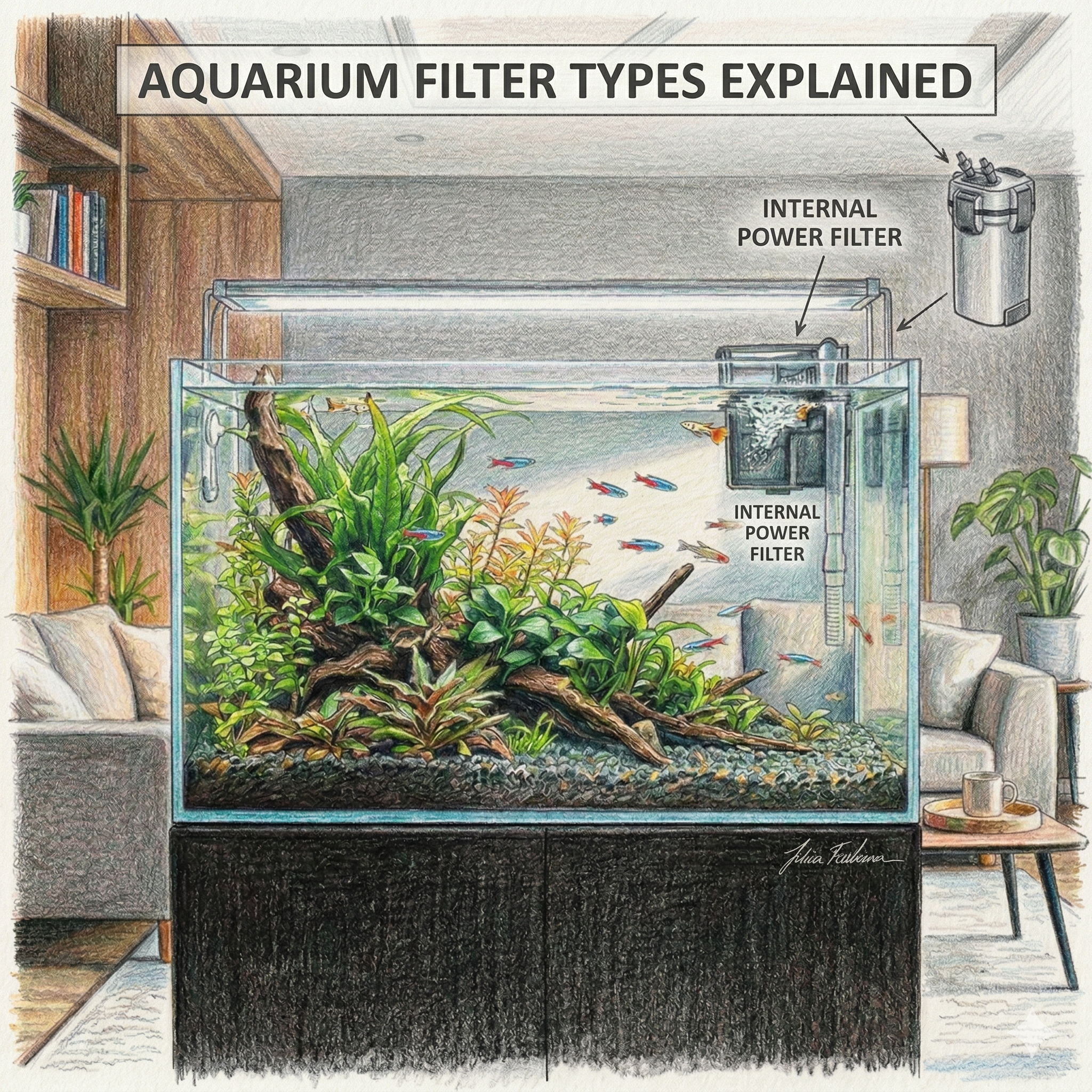
4. Internal Filters
Small pumps that sit completely inside the tank.
Best for
- Nano tanks
- Hospital tanks
- All-in-one kits
Strengths & Weaknesses
Compact but eats display space. Good backup or temporary option.
5. Undergravel Filters
Old-school system using the substrate as the filter bed.
Still functional for very basic low-tech tanks but generally outdated for modern planted or high-stock setups.
Best Filter by Situation (Updated 2026)
| Your Situation | Recommended Filter | Why It Wins |
|---|---|---|
| First 10–20 gal tank | HOB or Sponge | Best beginner balance |
| Betta tank | Sponge or low-flow HOB | Gentle flow is critical |
| Shrimp or fry tank | Sponge | Safest for babies |
| 20–40 gal community | Quality HOB | Easy & effective |
| 55+ gal display | Canister | Power + clean look |
| Small office tank | Quiet HOB | Low noise & neat |
| Heavily stocked / cichlids | Canister or oversized HOB | Handles waste load |
How to Choose the Right Filter – My Step-by-Step Process
- Start with tank size & stocking plan
- Decide how much maintenance you’ll actually do
- Prioritize flow needs of your fish
- Consider visibility and noise (especially for office)
- Budget for quality — cheap filters often cost more long-term in frustration
Common Filter Mistakes I’ve Made (So You Don’t)
- Buying too much flow for bettas/shrimp
- Replacing all media at once
- Ignoring pre-filters for small creatures
- Letting a HOB run dry and burn out the motor
Maintenance Schedule Cheat Sheet
- Sponge: Rinse in tank water every 2–4 weeks
- HOB: Clean pre-filter weekly, full media every 4–6 weeks
- Canister: Full clean every 2–3 months (never all at once)
Final Verdict
For most home and office aquariums in 2026, a good Hang-on-Back filter or Sponge filter will give you the best results with the least headache. Step up to a canister only when you need the extra power and are ready for the maintenance commitment.
Ready to choose?
Use the Aquarium Wizard for a personalized filter recommendation based on your tank size and goals.
Or check my Complete Beginner Tank Setup Guide.
Keep moving from reading to action.
Use the related guides to go deeper, check the shop if you need matching accessories, or join the email list for new guides and product updates.
Get new guides, product updates, and practical aquarium planning notes by email without waiting to check back manually.
Use the contact page if you want direct help instead of general email updates.
Related Guides
Aquarium Lighting Guide
Learn how to choose the right aquarium lighting for your home or office tank — intensity, spectrum, duration, timers, planted vs fish-only setups, and algae control. Real lessons from tanks in Norman, Oklahoma.
Aquascaping Basics: Creating Stunning Underwater Landscapes
Learn practical beginner aquascaping rules for home and office tanks — focal points, negative space, hardscape, plant grouping, and layouts that look intentional instead of cluttered. Real lessons from tanks in Norman, Oklahoma.
Complete Beginner Tank Setup Guide 2026
Step-by-step instructions for setting up your first home or office aquarium — from choosing equipment and location to cycling, stocking, and long-term success. Real lessons from tanks in Norman, Oklahoma.