
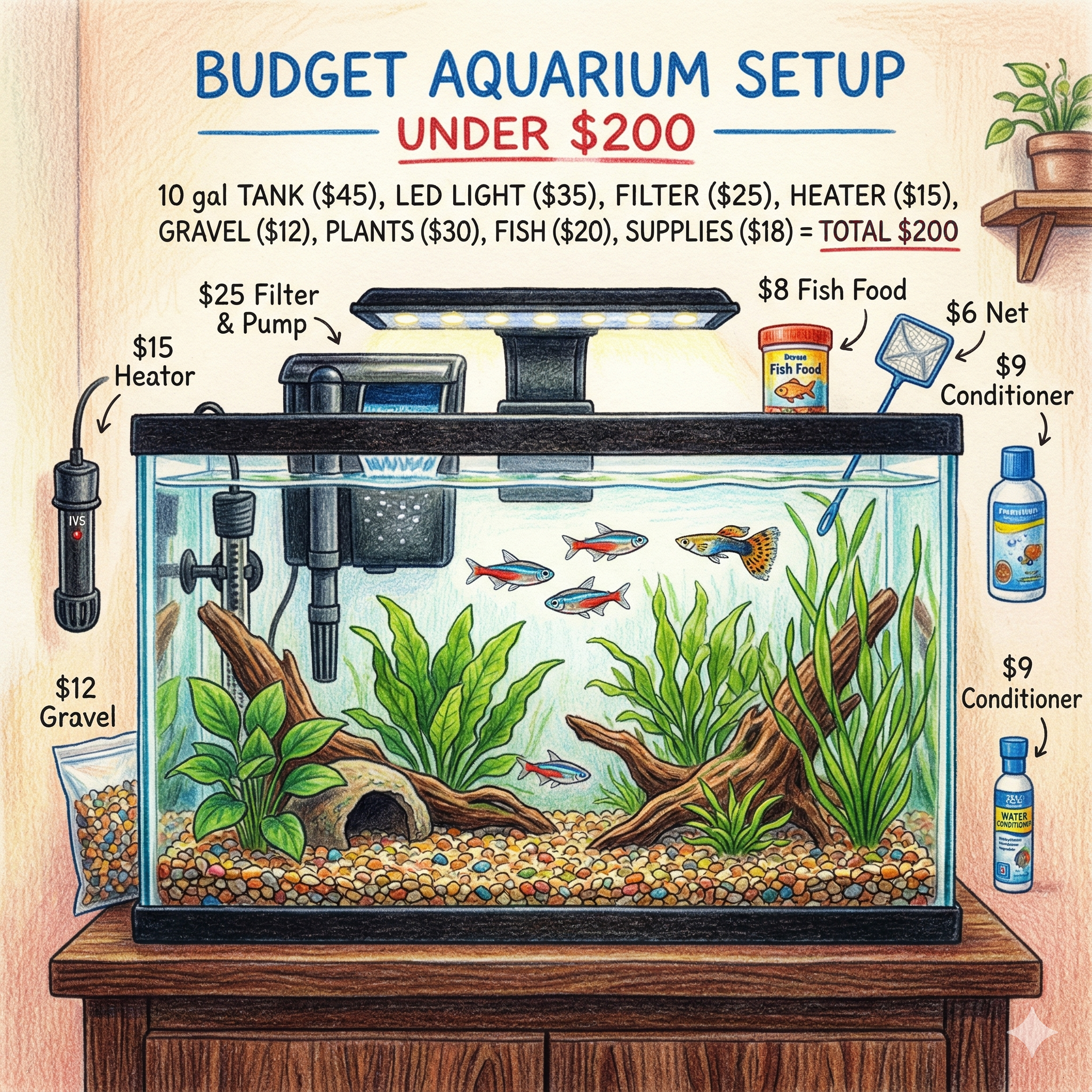
Budget Aquarium Setup Under $200
One of the biggest myths in aquarium keeping is that a low-cost tank has to be a bad tank. The real problem is not budget itself. The problem is spending the budget in the wrong order. Many beginners overspend on decorations, tiny novelty tanks, or unnecessary additives, then run out of money for the filter, heater, test kit, or maintenance tools that actually keep fish alive.
You can build a good beginner aquarium for under $200 if you keep the setup simple, choose the right tank size, and focus on freshwater fish instead of trying to force a complex display into a starter budget. That usually means a practical 5 to 10 gallon betta setup or a conservative 10 gallon freshwater community path. It does not mean cutting corners on safety.
This guide walks through how to build a realistic aquarium under $200, what to buy first, where to save money, and what to avoid if you want a tank that still feels stable after the first month.
Budget Setup at a Glance
| Budget Goal | Best Tank Style | Why It Works | Main Limitation |
|---|---|---|---|
| Under $125 | 5 gallon betta or shrimp-focused setup | Lowest startup cost with manageable gear list | Less stocking flexibility |
| $125 to $175 | 10 gallon beginner freshwater setup | Better stability and more room for error | Still needs conservative fish choices |
| $175 to $200 | Polished 10 gallon community or premium betta setup | Enough room for stronger equipment and nicer presentation | Not much margin for unnecessary extras |
Can You Really Build a Good Aquarium Under $200?
Yes, but only if you define “good” correctly.
A good budget tank is:
- freshwater instead of saltwater
- lightly stocked instead of crowded
- built around core equipment first
- simple enough to maintain every week
- sized for stability, not novelty
A bad budget tank is:
- too small to stay stable
- stocked before the cycle is ready
- dependent on weak or missing equipment
- overloaded with decorative extras and too little life-support gear
The goal is not to own the cheapest aquarium possible. The goal is to own the cheapest aquarium that still works well.
The Best Budget Tank Sizes
For a strict under-$200 build, the most realistic choices are:
5 Gallons
Best for:
- a single betta
- shrimp
- a carefully designed low-bioload setup
Pros:
- lower equipment cost
- less substrate and decor needed
- easier to fit in apartments and offices
Cons:
- less stable than 10 gallons
- more limited livestock options
- easier to overfeed or overcrowd
10 Gallons
Best for:
- a beginner betta setup with more room
- a conservative nano community
- small home or office freshwater tanks
Pros:
- better stability
- wider equipment selection
- more forgiving for beginners
Cons:
- slightly higher startup cost
- more pressure to choose fish carefully so you do not overcrowd
For most beginners, 10 gallons is the better budget target if the space allows it.
What You Actually Need to Buy
If the goal is an honest under-$200 setup, your essential shopping list usually looks like this:
- tank
- lid if not included
- filter
- heater if keeping tropical fish
- thermometer
- light
- water conditioner
- test kit
- substrate
- basic decor or plants
- fish food
- siphon or gravel vacuum
- bucket used only for aquarium care
Anything beyond that should be treated as optional until the system is stable.
Sample Budget Breakdown: 5 Gallon Betta Setup
This is often the easiest truly low-cost setup to do well.
| Item | Estimated Range |
|---|---|
| 5 gallon tank or starter kit | $35 to $60 |
| Gentle sponge filter or low-flow HOB | $12 to $25 |
| Air pump if using sponge filter | $10 to $18 |
| Heater | $15 to $22 |
| Thermometer | $3 to $8 |
| Substrate | $10 to $18 |
| Simple decor or easy plants | $10 to $20 |
| Water conditioner | $6 to $12 |
| Basic test kit | $18 to $35 |
| Food and net | $8 to $15 |
| Maintenance tool basics | $10 to $18 |
Typical total
About $137 to $251 depending on how many items are bundled, whether the tank is a kit, and how much decor you buy.
How to keep this path under $200
- choose a starter tank that includes light and lid
- use a sponge filter instead of a premium HOB
- buy a simple thermometer, not a branded digital upgrade
- keep decor minimal and natural-looking
- avoid unnecessary bottled additives
Sample Budget Breakdown: 10 Gallon Beginner Freshwater Setup
This is the most useful under-$200 target for beginners who want a stronger balance of stability and flexibility.
| Item | Estimated Range |
|---|---|
| 10 gallon tank or starter kit | $45 to $80 |
| HOB filter if not included | $20 to $35 |
| Heater | $18 to $28 |
| Thermometer | $3 to $8 |
| Substrate | $12 to $22 |
| Basic decor and one or two plants | $15 to $30 |
| Water conditioner | $6 to $12 |
| Test kit | $18 to $35 |
| Food and net | $8 to $15 |
| Siphon and bucket | $12 to $20 |
Typical total
About $157 to $285 depending on how much the starter kit already includes and how disciplined you are with decor and upgrades.
How to stay under $200 on a 10 gallon tank
- start with a basic freshwater setup, not a planted-tech layout
- avoid premium lights and specialty substrate
- keep fish choice simple
- use hardscape and a small number of decor pieces instead of overfilling the tank
- buy one solid test kit instead of several bottles of “fix” products
The Best Budget Strategy
The easiest way to stay under $200 is to divide everything into three groups.
Group 1: Non-Negotiable
Spend here first:
- tank and safe surface
- filter
- heater if needed
- water conditioner
- test kit
- thermometer
If the budget gets tight, these items still stay in the cart.
Group 2: Basic Presentation
Spend here second:
- substrate
- simple decor
- basic light if the tank does not include one
- food and maintenance tools
These items matter, but you can keep them simple.
Group 3: Delay Until Later
Wait on these:
- advanced planted-tank gear
- auto feeders
- premium lights
- extra chemicals
- decorative clutter
- specialty gadgets you do not yet understand
This is the category that often pushes a budget tank into an expensive, unstable one.
Where to Save Money Safely
Choose a Simple Freshwater Path
Freshwater is far cheaper and more forgiving than saltwater. If the budget is under $200, freshwater is the right answer almost every time.
Use a Starter Kit Selectively
Starter kits can save money when they include a usable tank, lid, and light. But do not assume the included filter or heater is always ideal. Review what is actually inside.
Keep the Decor Minimal
A tank with a few deliberate pieces looks better than a crowded tank full of impulse-buy ornaments. Minimal decor also leaves more room for fish movement and simpler maintenance.
Buy One Good Test Kit Instead of Multiple Additives
A test kit solves more real problems than random bottled products. The ability to test ammonia, nitrite, nitrate, and pH is more valuable than most “quick fix” chemistry products.
Use Easy Fish
Budget setups work best with fish that do not demand advanced equipment or expensive system upgrades.
Where Cutting Corners Usually Backfires
Skipping the Heater for Tropical Fish
If you are keeping bettas or most common beginner community fish, skipping the heater creates instability that often shows up later as stress, lethargy, or disease.
Buying a Tiny Bowl Instead of a Small Aquarium
Very small bowls often look cheap because they are cheap. They are also poor environments for most fish and much harder to keep stable.
Using Weak Filtration
A poor filter creates constant frustration. Cloudy water, weak flow, and unstable maintenance routines usually cost more in the long run than buying the right filter up front.
Skipping the Test Kit
This mistake is especially common in budget setups because testing feels less visible than buying decor. But clear water is not proof that the tank is cycled or safe.
Best Fish for a Budget Setup
The best budget livestock is livestock that does not force the system into complexity.
Strong choices
- one betta in a properly heated, filtered 5 to 10 gallon tank
- cherry shrimp in a stable planted or semi-planted nano tank
- a conservative nano community in a 10 gallon tank using small peaceful fish
Riskier choices for a strict budget
- goldfish
- aggressive cichlids
- messy fish that demand oversized filtration
- saltwater fish
- impulse mixed-species setups
Budget and simplicity usually go together.
Sample Under-$200 Paths
Path 1: Best Strict Budget Option
5 gallon betta setup
- 5 gallon starter tank with lid and light
- sponge filter and air pump
- heater and thermometer
- gravel or simple substrate
- one hide, one plant cluster, and open swimming space
- conditioner, test kit, food, siphon
Why it works:
- low livestock load
- manageable equipment costs
- easy fish focus
- gentle flow and simple maintenance
Path 2: Best Value Option
10 gallon beginner freshwater tank
- 10 gallon starter kit
- HOB filter
- heater and thermometer
- simple gravel and two or three decor pieces
- conditioner, test kit, food, and siphon
- conservative fish list
Why it works:
- more forgiving than a 5 gallon
- still realistic under $200 if upgrades are restrained
- better long-term flexibility
Path 3: Best Office Setup
Quiet desktop or side-table aquarium
- 5 to 10 gallon tank with lid
- quiet filter
- heater if tropical
- timer-compatible light
- minimal decor for easy cleaning
Why it works:
- cleaner presentation
- simple to manage around work routines
- easier to keep neat than a flashy, overbuilt display
Common Budget Aquarium Mistakes
Buying Too Much Decor
Decor is one of the fastest ways to break the budget without improving fish health.
Shopping Without a Stocking Plan
If you do not know whether the tank is for a betta, shrimp, or a nano community, it is easy to buy the wrong equipment.
Forgetting Ongoing Costs
Food, replacement media, water conditioner, and occasional maintenance tools still exist after startup. A budget tank should leave at least a little breathing room.
Treating Cheap as the Goal
Cheap is not the goal. Stable is the goal. The budget only works when the tank is still healthy after the excitement wears off.
Final Verdict
The best aquarium setup under $200 is usually a simple freshwater system built around the right tank size, a reliable filter, a heater when needed, water conditioner, a test kit, and restrained decor. For the tightest budgets, a betta setup is usually the easiest answer. For the best balance of stability and flexibility, a conservative 10 gallon freshwater tank is often the smarter investment.
The easiest way to fail on a budget is to chase appearance before stability. The easiest way to succeed is to buy the equipment that protects the tank first and let everything else wait.
Read Next
- Read the essential equipment guide if you want to refine what belongs in the cart and what should stay out.
- Read the beginner tank setup guide if you want to turn the shopping list into the right setup order.
- Read the nitrogen cycle guide before stocking fish, especially if the budget is tight and you want to avoid expensive beginner mistakes.
Affiliate note: this guide is naturally suited for future affiliate placements around starter kits, heaters, HOB filters, sponge filters, basic test kits, water conditioner, siphons, and beginner accessories, but the article should remain practical and price-conscious first.
PUBLIC_ADSENSE_GUIDE_INLINE_SLOT to enable this AdSense placement.
Keep moving from reading to action.
Use the related guides to go deeper, check the shop if you need matching accessories, or join the email list if you want future guides and product updates.
Get new guides, product updates, and practical aquarium planning notes by email without waiting to check back manually.
Use the contact page if you want direct help instead of general email updates.
Related Guides
Aquarium Filter Types Explained
Compare sponge, hang-on-back, canister, internal, and undergravel filters so you can choose the right aquarium filtration system for your tank size, fish, budget, and maintenance style.
Aquarium Lighting Guide
Learn how to choose aquarium lighting based on intensity, spectrum, timer control, plant needs, algae risk, and tank style so your setup looks good without becoming harder to maintain.
Complete Beginner Tank Setup Guide 2026
A complete step-by-step beginner aquarium setup guide covering tank size, equipment, cycling, stocking, and the most common mistakes that ruin first tanks.