
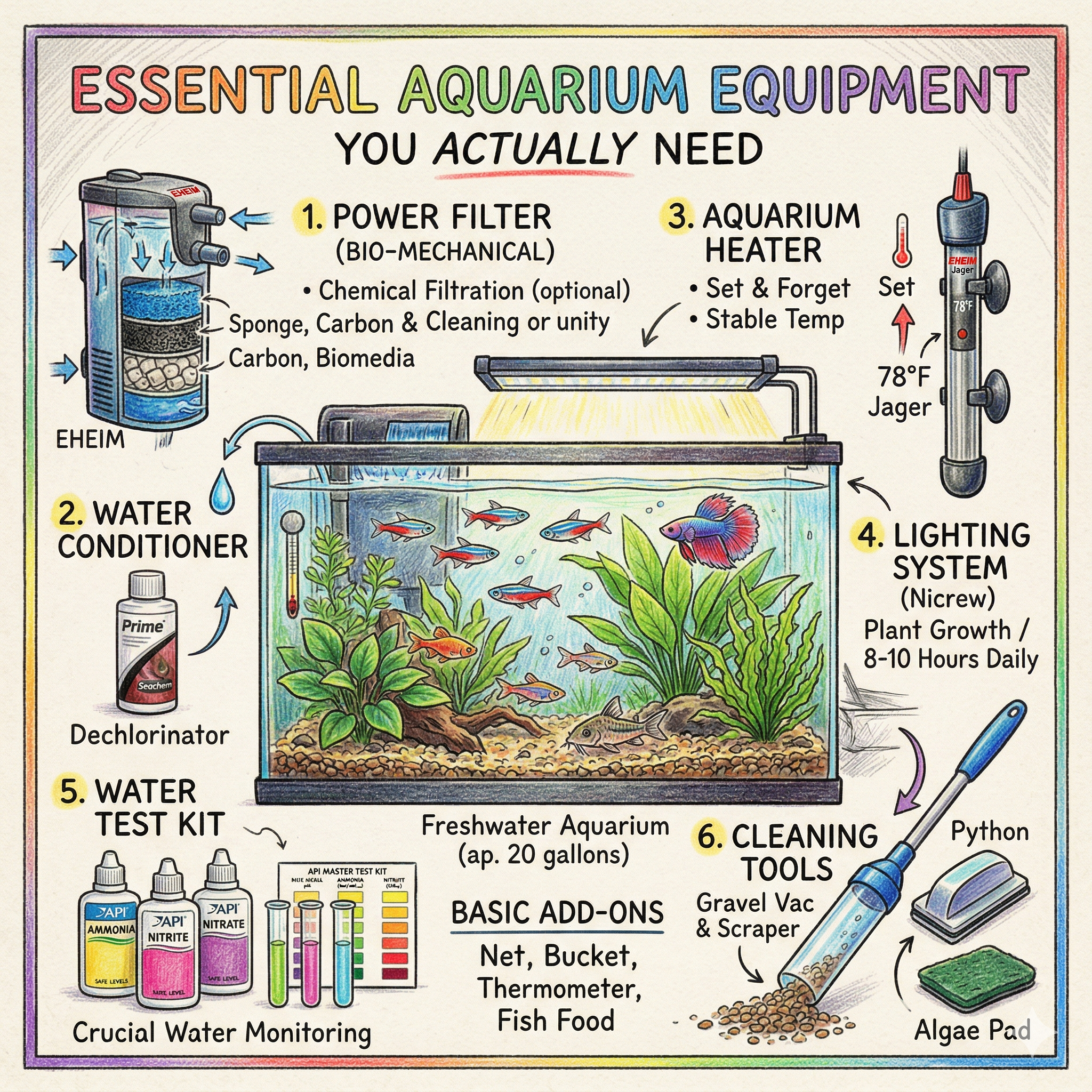
Essential Aquarium Equipment You Actually Need
Aquarium shopping gets expensive fast because most beginners are shown everything at once. Starter kits, extra gadgets, backup accessories, decorative add-ons, specialty chemicals, and impulse upgrades all get mixed together until it becomes hard to tell what is actually required to keep fish healthy. That confusion is where many first-tank mistakes begin.
The truth is simpler. A successful home aquarium usually depends on a short list of core equipment: the tank itself, a filter, the right heater when needed, a basic light, water conditioner, and a way to test the water. Everything else depends on the fish, the tank style, and how polished you want the setup to look. Some equipment is genuinely essential. Some is situational. Some is mostly noise.
This guide explains what equipment you actually need, what each item does, what can wait until later, and how to build a practical setup for a home or small-office aquarium without overspending.
Aquarium Equipment at a Glance
| Equipment | Essential for Most Tanks? | What It Does | Can It Wait? |
|---|---|---|---|
| Aquarium and stand | Yes | Holds the system safely and supports total tank weight | No |
| Filter | Yes | Provides water movement, debris capture, and biological filtration | No |
| Heater | Usually | Keeps tropical freshwater and many saltwater tanks stable | Not if you keep tropical fish |
| Light | Yes | Lets you view the tank and supports plant growth if needed | No |
| Water conditioner | Yes | Makes tap water safe by neutralizing chlorine and chloramine | No |
| Water test kit | Yes | Confirms cycling progress and ongoing water quality | No |
| Substrate | Usually | Supports decor, plants, and tank appearance | Usually no |
| Thermometer | Yes | Confirms the heater is actually maintaining the right temperature | No |
| Fish net and siphon | Yes | Supports normal maintenance and livestock handling | No |
| Air pump | Sometimes | Adds surface agitation or powers sponge filters | Yes, if the filter already provides enough movement |
| Timer | Helpful | Keeps lighting consistent without manual effort | Yes, but worth adding early |
| Auto feeder | Situational | Helps with routine feeding when away from home or office | Yes |
The Core Equipment Every Beginner Should Understand
1. The Aquarium Itself
The tank is the foundation of every equipment decision that follows. Size affects fish stocking, filter choice, heater strength, maintenance stability, and long-term cost.
For most beginners, a tank in the 10 to 20 gallon range is easier than a tiny bowl or ultra-small desktop tank. More water volume creates a better buffer against ammonia spikes, temperature swings, and overfeeding mistakes. Very small aquariums can look simple, but they are often less forgiving.
What to prioritize
- a tank size you can realistically maintain
- a reliable stand or surface rated for the weight
- enough clearance behind or above the tank for equipment access
- a lid if you are keeping jumping fish or want slower evaporation
What beginners often get wrong
- choosing a tank purely by desk size without checking weight
- buying a very small tank because it looks easier
- forgetting that gravel, decor, and water make the final system far heavier than expected
2. The Filter
The filter is one of the few pieces of equipment that almost every healthy aquarium genuinely needs. It supports water movement, traps debris, and most importantly gives beneficial bacteria a stable place to live.
For most beginner freshwater tanks, a hang-on-back filter is the default best answer. Sponge filters are excellent for bettas, shrimp, quarantine tanks, or low-budget setups. Canister filters make more sense on larger or heavier-stocked display tanks.
Your real goal
You are not buying a filter to create a waterfall effect. You are buying a stable home for biological filtration and a maintenance rhythm you can actually keep up with.
Good beginner rule
- 5 to 10 gallons: sponge filter or adjustable low-flow HOB
- 10 to 40 gallons: HOB filter for most freshwater community tanks
- 40 gallons and up: strong HOB or canister depending on fish load and presentation goals
If you need a deeper breakdown, read the filter types guide after this article.
3. The Heater
Many of the most popular aquarium fish are tropical fish. That means they need stable warm water, not just a room that feels comfortable to you.
For bettas, tetras, rasboras, corydoras, guppies, and most common beginner freshwater fish, a heater is usually essential. Without one, the tank can drift too cool overnight or during seasonal changes. That instability creates stress and weakens fish over time.
Tanks that usually need a heater
- betta tanks
- most tropical freshwater community tanks
- most saltwater tanks
- tanks in offices where HVAC schedules create temperature swings
Tanks that may not
- some coldwater or room-temperature species
- tanks in consistently warm spaces, though you still need to verify the real temperature
What matters most
- correct wattage for tank size
- a reliable thermostat
- pairing it with a thermometer instead of assuming it works correctly
4. The Light
Every aquarium needs some kind of lighting, but not every tank needs a high-end planted-tank fixture. For many beginners, the first job of the light is simply to let you enjoy the aquarium and keep a regular day-night cycle.
If you are not growing demanding live plants, you do not need to overbuy here. Too much light without a real plant plan often creates algae trouble instead of a better aquarium.
Keep it simple if:
- the tank uses artificial plants
- the setup is a basic community tank
- the tank sits in an office or living room and only needs clean display lighting
Spend more if:
- you want a planted tank
- you care about color rendering and presentation
- you need timer control and intensity adjustment
5. Water Conditioner
Water conditioner is not optional for most tap-water users. Chlorine and chloramine make water safe for people to drink, but they can damage fish gills and beneficial bacteria if added untreated to an aquarium.
Every water change should start with the assumption that fresh tap water needs conditioning unless you have verified otherwise for your local source.
This is one of the easiest products to overlook because it is small and inexpensive compared with the tank and filter. It is also one of the fastest ways to ruin a new setup if you skip it.
6. A Water Test Kit
This is where many beginner equipment lists fail. They include decorations, food, and bottles of optional additives, but leave out the actual tool that tells you whether the tank is safe.
A water test kit matters because clear water does not mean safe water. Ammonia and nitrite can be dangerous long before anything looks visibly wrong. During cycling and the first months of ownership, testing is what separates guessing from knowing.
Parameters beginners should be able to test
- ammonia
- nitrite
- nitrate
- pH
If you keep more specialized fish later, you may also care about hardness, alkalinity, or salinity. For a first freshwater setup, the basics above carry most of the workload.
7. A Thermometer
If you have a heater, you also need a thermometer. Too many hobbyists install a heater and never verify the actual tank temperature. A thermometer gives you a quick visual check that the system is holding steady.
That matters in homes and offices where the room temperature changes between day and night, weekdays and weekends, or summer and winter.
8. Maintenance Tools
At minimum, most owners need:
- a siphon or gravel vacuum
- a dedicated aquarium bucket
- a fish net
- an algae pad or scraper
These are not glamorous purchases, but they are part of what makes a tank sustainable. A tank that is awkward to clean becomes a tank that gets neglected.
Equipment That Is Often Helpful, But Not Always Essential
Some equipment can make aquarium keeping easier without being mandatory on day one.
Air Pump
An air pump is useful when:
- you run a sponge filter
- you want extra surface agitation
- you keep fish that benefit from more oxygen exchange
- you want a backup aeration option during troubleshooting
But many tanks do not need a separate air pump if the filter already moves water effectively at the surface. Beginners often assume bubbles equal health. They do not. Surface exchange and appropriate flow matter more than bubbles for their own sake.
Timer
A light timer is one of the best low-cost quality-of-life upgrades because it creates consistency. That helps fish, reduces forgotten lights, and can make algae management easier.
It is not strictly essential on the first day, but it is one of the first upgrades worth making.
Lid or Cover Glass
Many fish jump. A lid also reduces evaporation, keeps dust out, and helps stabilize temperature. Some tanks come with one; some do not. Whether it is essential depends on the livestock and setup.
Power Strip With Drip Loops
This is not the exciting part of the hobby, but safe cable management matters. Multiple aquarium devices plugged into one area means you should think about surge protection, outlet access, and keeping cords arranged safely below the outlet line.
Equipment Beginners Commonly Buy Too Early
Extra Chemicals
Many new hobbyists buy a shelf full of water “fixes” before they understand the tank. In most beginner freshwater setups, the truly necessary chemical product is a water conditioner. After that, restraint is usually smarter than panic buying.
Oversized Lights
Strong lighting without a plant plan often feeds algae more than it improves the aquarium.
Large Canister Filters for Small Tanks
Canister filters have a place, but they are often unnecessary on a straightforward first 10 or 20 gallon setup.
Fancy CO2 Systems
CO2 can be valuable for advanced planted tanks, but it is not part of a normal beginner equipment list.
Auto Feeders on Day One
An auto feeder is useful for travel or office routines, but manual feeding is usually better when learning how much your fish actually need.
Equipment by Tank Type
Basic Beginner Freshwater Community Tank
For a practical 10 to 20 gallon home setup, the essential equipment usually looks like this:
- glass aquarium with lid
- stand or sturdy level surface
- HOB filter
- heater
- thermometer
- light
- water conditioner
- water test kit
- gravel vacuum and bucket
- fish net
That is enough to build a stable beginner tank without unnecessary clutter.
Betta Tank
A betta setup usually needs:
- 5 gallon or larger aquarium with lid
- gentle sponge filter or low-flow HOB
- heater
- thermometer
- basic light
- water conditioner
- test kit
- maintenance tools
The key difference is gentle flow and stable warmth.
Small Office Aquarium
An office tank benefits from:
- conservative tank size
- quiet filter
- secure lid
- timer for lighting
- simple maintenance tools stored nearby
Office tanks should be chosen for reliability and routine rather than complexity.
Beginner Saltwater Tank
Saltwater gear adds more system requirements, but the basic list still includes:
- aquarium and stand
- marine-appropriate filtration strategy
- heater
- stronger circulation planning
- marine test tools
- salt mix and mixing container
- hydrometer or refractometer
Saltwater is not just “freshwater plus salt.” The equipment demands are higher and the margin for error is smaller.
The Best Beginner Budget Strategy
If the budget is tight, spend first on the items that protect stability:
- tank and safe stand
- filter
- heater if the fish need one
- water conditioner
- test kit
- light
- maintenance tools
This order matters because a beautiful tank without stable filtration or safe water is still a bad setup.
If you need to delay purchases, delay decorative upgrades first, not life-support equipment.
Common Beginner Equipment Mistakes
Buying for Aesthetics Before Function
A neat-looking tank with poor filtration and no test kit is not actually a better setup. Beginners often spend more on decorations than the equipment that keeps fish alive.
Trusting a Starter Kit Without Reviewing the Parts
Starter kits can be fine, but they are not automatically complete. Some include weak lights, basic filters, or heaters that do not match your intended fish.
Skipping the Test Kit
This is one of the most common errors in beginner tank planning. Without testing, many owners only discover problems after fish show stress.
Assuming Every Tank Needs an Air Pump
Not every aquarium needs bubbling decor or extra aeration hardware. The tank needs proper oxygen exchange, not random equipment.
Underestimating Noise
For bedroom, office, or living room tanks, filter noise, bubbling noise, and lid vibration matter more than many buyers expect.
What You Can Safely Add Later
Once the tank is stable, you can add equipment that improves convenience or presentation:
- programmable timer
- upgraded light
- intake sponge or pre-filter
- auto feeder
- better aquascaping tools
- backup air pump
- branded accessories and custom printed add-ons
These are best treated as upgrades, not starting requirements.
Sample Equipment Bundles
Simple 10 Gallon Beginner Freshwater Tank
- 10 gallon glass aquarium with lid
- HOB filter or sponge filter
- 50 watt heater
- thermometer
- basic LED light
- water conditioner
- liquid test kit
- gravel vacuum
- fish net
Betta-Focused Setup
- 5 to 10 gallon tank with lid
- sponge filter and air pump
- heater
- thermometer
- gentle LED light
- water conditioner
- test kit
- siphon and algae pad
Small Office Display Tank
- 10 to 15 gallon tank
- quiet HOB or internal filter
- heater
- lid
- timer-controlled light
- water conditioner
- test kit
- maintenance kit stored in one container
Final Verdict
The equipment you actually need is the equipment that keeps the tank stable, readable, and maintainable. For most first freshwater aquariums, that means a good filter, the right heater, a light, a water conditioner, a thermometer, a test kit, and simple cleaning tools. Everything beyond that should earn its place.
The smartest beginner setup is not the one with the most gear. It is the one with the fewest weak points.
Read Next
- Read the beginner tank setup guide if you want help turning this equipment list into a real setup order.
- Read the nitrogen cycle guide if you want to understand why the filter and test kit matter so much.
- Read the filter types guide if you are still deciding between sponge, HOB, and canister filtration.
Affiliate note: this guide is naturally suited for future affiliate placements covering filters, heaters, thermometers, test kits, timers, siphons, lids, and maintenance tools, but the article should stay practical rather than sales-first.
PUBLIC_ADSENSE_GUIDE_INLINE_SLOT to enable this AdSense placement.
Keep moving from reading to action.
Use the related guides to go deeper, check the shop if you need matching accessories, or join the email list if you want future guides and product updates.
Get new guides, product updates, and practical aquarium planning notes by email without waiting to check back manually.
Use the contact page if you want direct help instead of general email updates.
Related Guides
Aquarium Filter Types Explained
Compare sponge, hang-on-back, canister, internal, and undergravel filters so you can choose the right aquarium filtration system for your tank size, fish, budget, and maintenance style.
Aquarium Lighting Guide
Learn how to choose aquarium lighting based on intensity, spectrum, timer control, plant needs, algae risk, and tank style so your setup looks good without becoming harder to maintain.
Complete Beginner Tank Setup Guide 2026
A complete step-by-step beginner aquarium setup guide covering tank size, equipment, cycling, stocking, and the most common mistakes that ruin first tanks.