
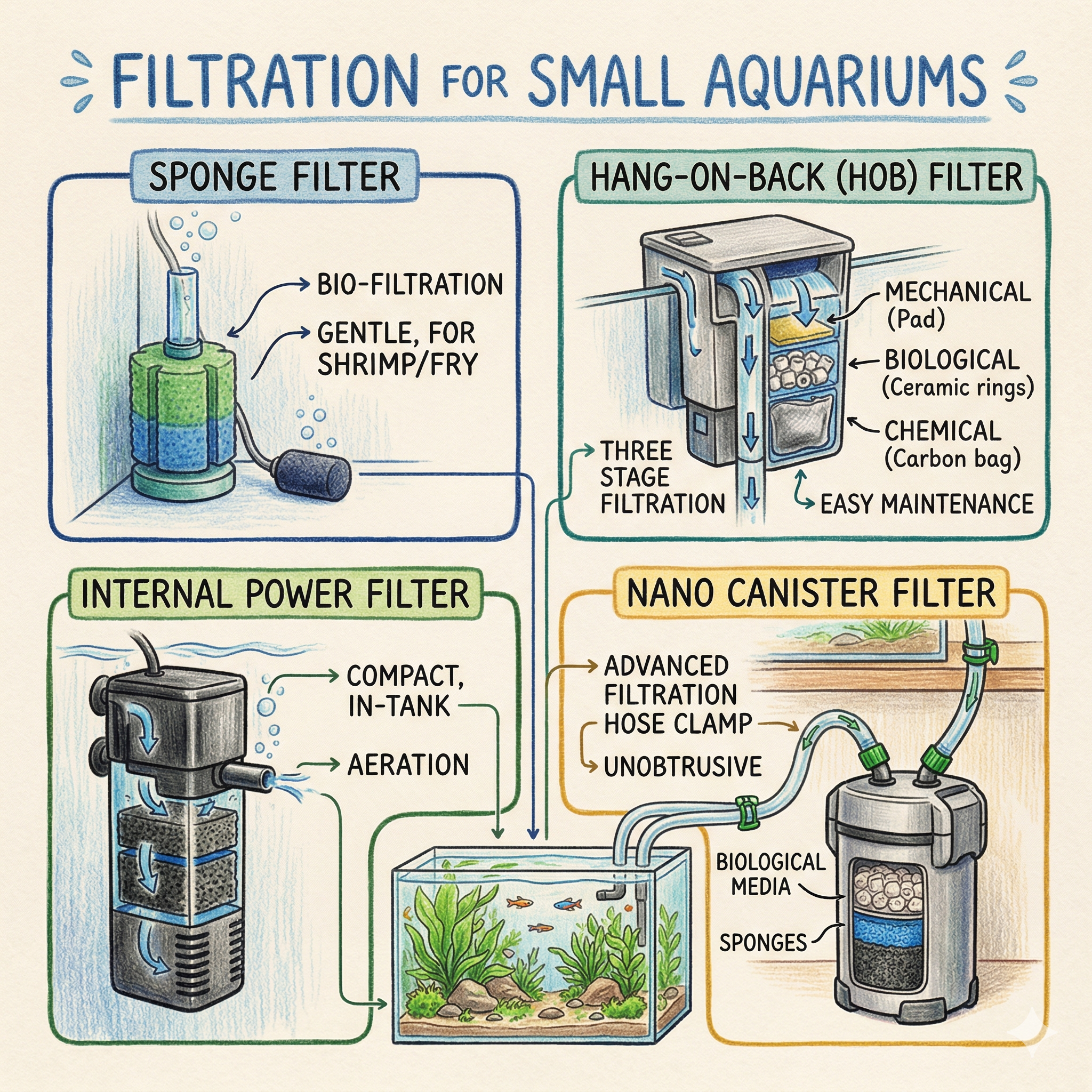
Filtration Systems for Small Aquariums
Small aquariums are often sold as easy tanks, but they are only easy when the equipment is chosen carefully. In a 5 to 20 gallon setup, the filter matters even more than many beginners expect because there is less water volume to absorb mistakes. Too much flow can stress the fish. Too little filtration can leave the water dull and unstable. A filter that is awkward to clean can turn a simple tank into one you start avoiding.
That is why “small tank filter” is not a one-size-fits-all purchase. The best choice depends on the fish, the space around the aquarium, the noise level you can tolerate, and how visible you want the hardware to be. A sponge filter can be perfect for one setup and annoying in another. A small hang-on-back filter can be ideal for a 10 gallon community tank but a poor fit for a long-finned betta if the flow is too strong.
This guide focuses specifically on filtration for small home and office aquariums, including the strengths and weaknesses of sponge, hang-on-back, internal, and small canister filters, how to choose among them, and what mistakes to avoid.
Small Aquarium Filtration at a Glance
| Filter Type | Best For | Biggest Advantage | Biggest Watch-Out |
|---|---|---|---|
| Sponge filter | Bettas, shrimp, fry, quarantine tanks, low-budget nano tanks | Gentle flow and excellent biological filtration | Visible in the tank and not the best at polishing water |
| Hang-on-back filter | Most 10 to 20 gallon beginner freshwater tanks | Easy maintenance and strong all-around value | Can create too much current in tiny tanks |
| Internal filter | Compact office tanks and simple all-in-one setups | Small footprint outside the tank and easy installation | Uses visible space inside the tank |
| Small canister filter | Premium nano displays and cleaner-looking setups | Strong media capacity with hidden main hardware | Higher cost and more complex maintenance |
Why Small Aquariums Need the Right Filter More Than the Biggest Filter
In larger aquariums, extra water volume helps buffer mistakes. In small aquariums, problems usually show up faster.
That means the right filter should:
- keep water moving without blasting the fish
- support beneficial bacteria reliably
- fit the physical space around the tank
- be easy enough to maintain on schedule
The wrong filter usually creates one of three outcomes:
- too much current
- too little real filtration
- a maintenance routine you resent
In a small aquarium, convenience and fit matter as much as raw performance.
What a Filter Needs to Do in a Small Tank
Every good aquarium filter contributes to three jobs:
- mechanical filtration, which traps debris
- biological filtration, which supports beneficial bacteria
- chemical filtration when used, which can remove specific dissolved impurities
For most small freshwater tanks, biological stability and manageable flow matter more than fancy chemical media. The filter should make the tank easier to keep, not more complicated.
The Best Filter Types for Small Aquariums
1. Sponge Filters
Sponge filters are one of the safest and most forgiving choices for small tanks. They use an air pump to move water gently through a sponge, which traps debris and grows beneficial bacteria.
Best for
- betta tanks
- shrimp tanks
- fry tanks
- quarantine tanks
- low-budget beginner setups
Why they work well in small tanks
- very gentle water movement
- safe for weak swimmers and tiny livestock
- inexpensive
- excellent biological filtration
- easy to rinse during maintenance
Limitations
- less effective water polishing than some HOB filters
- visible inside the display
- require an air pump and tubing outside the tank
- bubbling noise may bother some users in quiet rooms
Bottom line
For many 5 to 10 gallon tanks, especially betta and shrimp setups, a sponge filter is one of the best choices available.
2. Hang-On-Back Filters
Hang-on-back filters, or HOB filters, are often the best all-around answer for small freshwater community tanks from about 10 to 20 gallons.
Best for
- beginner community tanks
- 10 to 20 gallon freshwater setups
- owners who want easy cartridge or media access
- users who prefer less equipment inside the tank
Why they work well
- easy to install
- good balance of mechanical and biological filtration
- relatively easy to clean
- often gives clearer-looking water than sponge-only filtration
Watch-outs in small tanks
- waterfall return can be too strong
- some models are noisy if water level drops
- cartridges tempt beginners to replace media too aggressively
- not every desk or wall placement leaves room behind the tank
Bottom line
For many 10 gallon beginner tanks, a HOB filter is the easiest practical choice, as long as the flow suits the fish.
3. Internal Filters
Internal filters sit inside the aquarium and are common in compact or all-in-one setups.
Best for
- very tight spaces
- office tanks where back clearance is limited
- simple hospital or backup tanks
- owners who want plug-and-run simplicity
Why they can work
- compact and easy to place
- less concern about behind-tank clearance
- often simple to remove and rinse
Limitations
- visible inside the aquarium
- takes away swimming or decor space
- usually less flexible than a HOB or canister setup
Bottom line
Internal filters are practical, not glamorous. They can be a very workable choice when space around the tank matters more than presentation.
4. Small Canister Filters
Small canister filters are usually not the default answer for beginner nano tanks, but they have a role in higher-end small displays.
Best for
- polished nano displays
- tanks where you want the main hardware hidden
- owners who value larger media capacity in a small footprint tank
Why people choose them
- more customizable filtration media
- cleaner tank appearance
- quieter operation in some setups
Limitations
- more expensive
- more involved cleaning
- usually unnecessary for a simple beginner tank
Bottom line
A small canister can be excellent, but it is usually a premium choice, not the most practical first choice.
Best Filter by Small Tank Type
5 Gallon Betta Tank
Best choices:
- sponge filter
- very gentle adjustable HOB filter
Why:
- current control matters more than raw filtration strength
- the fish should not be pushed around constantly
5 to 10 Gallon Shrimp Tank
Best choice:
- sponge filter
Why:
- baby shrimp safety
- gentle flow
- strong biological support
10 Gallon Beginner Community Tank
Best choices:
- small HOB filter
- sponge filter if stocking is light and the owner accepts the visual tradeoff
Why:
- community tanks usually benefit from a bit more debris capture and clearer water movement
15 to 20 Gallon Office Tank
Best choices:
- quiet HOB filter
- compact internal filter if space behind the tank is limited
Why:
- maintenance convenience and neat presentation matter
Quarantine or Hospital Tank
Best choice:
- sponge filter
Why:
- simple, safe, and easy to keep cycled if planned correctly
How to Match Filter Flow to the Fish
This matters more in small tanks because fish cannot escape strong current as easily.
Fish that usually need gentler flow
- bettas
- shrimp
- fry
- some long-finned or weak-swimming fish
Fish that usually tolerate moderate flow better
- many small community species
- active schooling fish in appropriately sized setups
If the fish hides constantly from the filter output, struggles to hold position, or avoids part of the tank, the setup needs to be adjusted.
Small Tank Filter Noise: What Beginners Overlook
In bedrooms, living rooms, and offices, noise matters.
Common noise sources
- bubbling from sponge filters
- low water level causing HOB waterfall noise
- vibration from an air pump
- impeller wear or trapped debris
Quietest-feeling solutions often come from
- keeping HOB water return aligned with water level
- placing air pumps carefully
- cleaning impellers before they become noisy
- choosing a filter style that matches the room, not just the tank
Some people hate bubbling. Others hate visible in-tank hardware. This is why the “best” filter is partly personal.
Maintenance: The Filter You Will Actually Clean Wins
Small tanks are supposed to be manageable, so a filter that turns maintenance into a chore is a bad fit even if it performs well on paper.
Easy maintenance wins in small tanks because:
- debris becomes noticeable faster
- neglected filters lose performance quickly
- owners are more likely to stay consistent when cleanup is simple
Beginner-safe maintenance rule
- inspect the filter weekly
- rinse media gently in removed tank water as needed
- do not replace all biological media at once
A small tank stays healthier when the filter routine is easy enough to repeat without dread.
Common Small Aquarium Filtration Mistakes
Buying Too Much Flow
This is especially common in betta and nano tanks.
Assuming Tiny Tanks Need Tiny Filtration
Small aquariums still need stable biological filtration. “Mini” should not mean weak.
Ignoring Safety Around Intakes
Shrimp, fry, and delicate fins may need intake guards or sponge pre-filters.
Replacing Cartridges Too Aggressively
Throwing out established media can destabilize the tank.
Choosing a Filter Without Checking Tank Placement
A HOB filter may be great until you realize the tank is flush against a wall or desk divider.
Which Filter Is Best for Most Beginners?
For most small beginner freshwater tanks:
- choose a sponge filter for bettas, shrimp, quarantine tanks, and gentle low-flow setups
- choose a HOB filter for many 10 to 20 gallon community tanks
- choose an internal filter when space around the tank is tight
- choose a small canister only if you specifically want a cleaner premium display and accept the extra complexity
The best filter for a small aquarium is the one that fits the fish, the space, and the maintenance reality of the owner.
Final Verdict
For small aquariums, filtration should be gentle, reliable, and easy to live with. Sponge filters are often the best answer for bettas, shrimp, and simple nano setups. HOB filters are usually the strongest all-around choice for small community tanks. Internal filters work well when space is limited, and small canisters are better treated as premium upgrades than beginner defaults.
A small tank does not need the most powerful filter. It needs the filter that keeps the tank stable without making the fish struggle or the owner procrastinate maintenance.
Read Next
- Read the aquarium filter types guide if you want a broader comparison beyond small tanks.
- Read the betta tank basics guide if you are filtering a low-flow setup.
- Read the essential equipment guide if you are still building the complete shopping list for a first aquarium.
Affiliate note: this guide is naturally suited for future affiliate placements covering sponge filters, air pumps, HOB filters, intake guards, pre-filters, and nano-safe maintenance tools, but the article should stay setup-first rather than product-first.
PUBLIC_ADSENSE_GUIDE_INLINE_SLOT to enable this AdSense placement.
Keep moving from reading to action.
Use the related guides to go deeper, check the shop if you need matching accessories, or join the email list if you want future guides and product updates.
Get new guides, product updates, and practical aquarium planning notes by email without waiting to check back manually.
Use the contact page if you want direct help instead of general email updates.
Related Guides
Aquarium Filter Types Explained
Compare sponge, hang-on-back, canister, internal, and undergravel filters so you can choose the right aquarium filtration system for your tank size, fish, budget, and maintenance style.
Aquarium Lighting Guide
Learn how to choose aquarium lighting based on intensity, spectrum, timer control, plant needs, algae risk, and tank style so your setup looks good without becoming harder to maintain.
Complete Beginner Tank Setup Guide 2026
A complete step-by-step beginner aquarium setup guide covering tank size, equipment, cycling, stocking, and the most common mistakes that ruin first tanks.