Goldfish Care Myths Busted
Goldfish are some of the most commonly misunderstood aquarium fish in the hobby. They are often treated like decorative beginner pets that can live in bowls, survive on minimal care, and stay small no matter what tank they are placed in. That picture is wrong on almost every level. Goldfish can be hardy fish, but that does not mean they are low-needs fish. In fact, many of the most common goldfish problems come directly from bad assumptions that have been repeated for years.
The biggest issue is that goldfish are usually marketed as simple starter fish while being kept in conditions that would make almost any aquarium fish decline. Small bowls, weak filtration, poor feeding habits, and infrequent water changes create the exact environment that causes stunting, stress, and chronic poor water quality. The fish may survive for a while, but surviving is not thriving.
This guide breaks down the most common goldfish myths, what the reality actually is, and how to build a healthier home setup for goldfish in the USA without repeating the same avoidable mistakes.
Goldfish Care at a Glance
| Myth | Reality | Why It Matters |
|---|---|---|
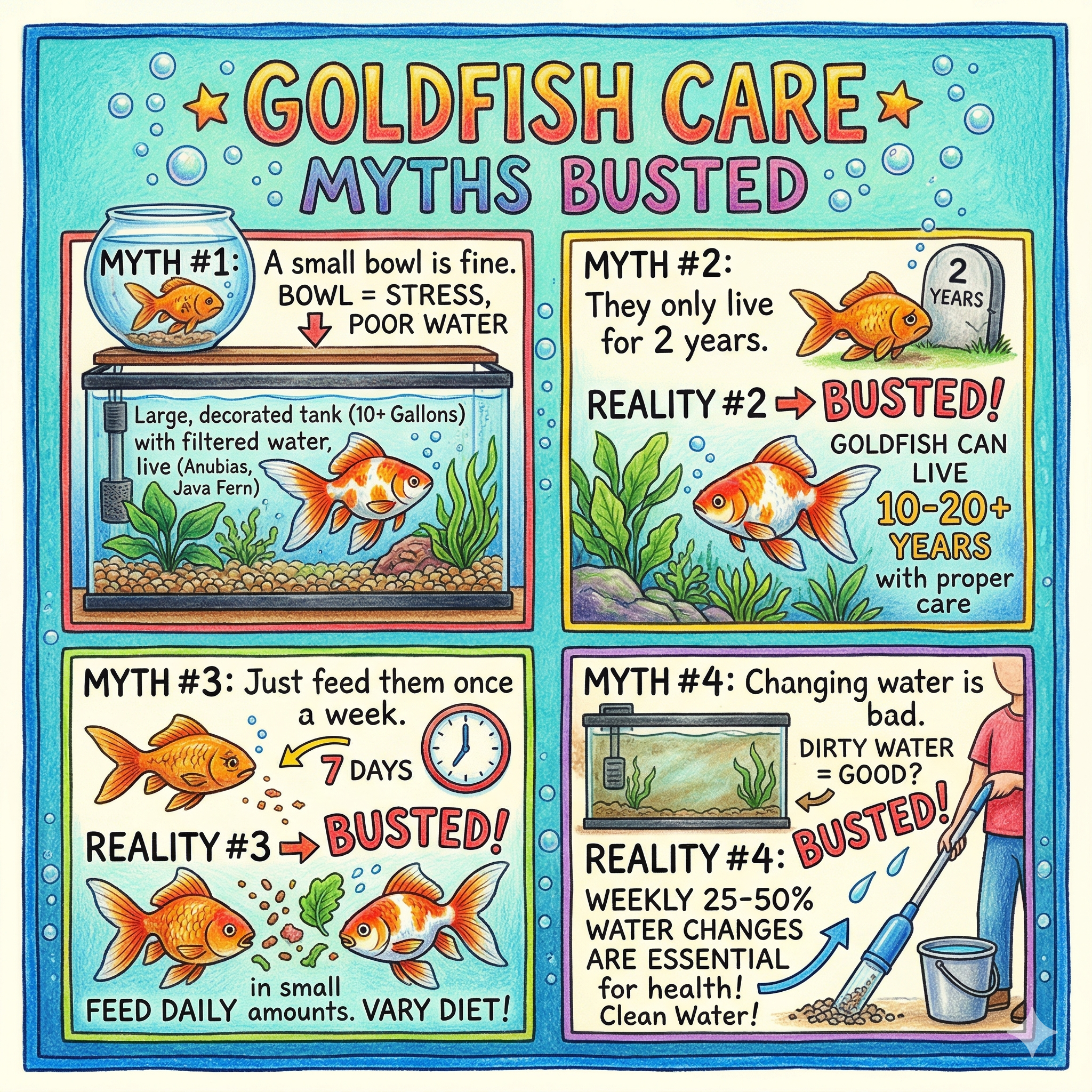
| Goldfish can live in bowls | Bowls are one of the worst common goldfish setups | Poor volume and weak filtration create unstable water |
| Goldfish only live a short time | Goldfish can live for many years with proper care | Short lifespan usually reflects poor husbandry, not normal biology |
| Goldfish stay small if the tank is small | Small tanks often stunt growth and worsen health | Tank size does not “solve” adult size safely |
| Goldfish need very little maintenance | Goldfish are heavy waste producers that need real upkeep | Water quality declines quickly in poor setups |
Myth 1: A Small Bowl Is Fine
This is probably the most damaging goldfish myth of all.
Why bowls fail
- too little water volume
- poor temperature stability
- weak or nonexistent filtration
- not enough swimming space
- rapid waste buildup
Goldfish produce a lot of waste for their size. In a bowl, that waste concentrates quickly. Even if the water looks clear, the chemistry usually becomes unstable much faster than beginners realize.
What the reality looks like
Goldfish need a real aquarium or pond-style environment with:
- enough water volume
- strong filtration
- room to move normally
- a realistic maintenance schedule
A bowl is not a minimalist goldfish habitat. It is usually a stress chamber.
Myth 2: Goldfish Only Live for a Year or Two
This myth is common because many store-bought goldfish do die early. The mistake is assuming that short life is normal.
The reality
With appropriate care, goldfish can live much longer than the typical “starter pet” timeline. When they die young, it is usually because of:
- chronic poor water quality
- under-sized living space
- weak filtration
- poor feeding practices
- long-term stress
A short goldfish lifespan is more often a warning about care conditions than a statement about the fish itself.
Myth 3: Goldfish Stay Small if the Tank Is Small
This is one of those myths that persists because people see part of the effect and misunderstand the cause.
What actually happens
A goldfish in a too-small setup may not grow properly, but that does not mean the tank is safely “controlling” its size. It usually means the fish is being restricted by poor conditions and chronic stress.
Why that matters
Goldfish that are forced into undersized systems often face:
- poor body development
- organ stress
- dirty water
- higher disease risk
Small growth under bad conditions is not evidence that the setup is working. It is often evidence that it is not.
Myth 4: Goldfish Are Easy Because They Are Hardy
Goldfish are hardy in the sense that they can survive poor care longer than some delicate tropical fish. That does not make them an easy low-maintenance choice.
Why they are often harder than beginners expect
- they are messy eaters
- they produce significant waste
- they need better filtration than many people assume
- they need consistent water changes
- many setups marketed for goldfish are simply too small
Hardy fish still deserve correct care.
Myth 5: Water Changes Are Optional If the Filter Is Running
A filter helps, but it does not replace water changes.
Goldfish tanks often accumulate:
- nitrate
- dissolved waste
- uneaten food debris
- general organics
Because goldfish are such heavy waste producers, water changes matter a lot. A weak water-change routine is one of the fastest ways to turn a goldfish tank into a chronic water-quality problem.
Practical rule
Goldfish care should assume:
- real filtration
- real water changes
- regular observation
not “set it and forget it.”
Myth 6: Goldfish Can Eat Infrequently and Be Fine
Goldfish are often fed casually or inconsistently because they are seen as simple pets. That creates two opposite problems:
- underfeeding or poor nutritional variety
- overfeeding in dirty tanks
Better feeding reality
Goldfish do best with:
- measured feeding
- consistent routine
- a diet that is not just random flakes once in a while
The exact feeding schedule depends on the fish, the tank, and the food type, but goldfish should not be treated as animals that can thrive on neglect.
What Goldfish Actually Need
If you strip away the myths, goldfish care becomes much more straightforward.
Core needs
- appropriate tank or pond-size environment
- strong filtration
- regular partial water changes
- enough room to swim
- a realistic maintenance routine
- a measured feeding plan
The mistake is not that goldfish are “difficult.” The mistake is that they are often kept in systems designed for convenience instead of biology.
Why Goldfish Produce So Many Water-Quality Problems
Goldfish are one of the fish groups that exposes weak maintenance quickly.
Common reasons
- high waste production
- heavy feeding in too little water
- underpowered filtration
- tanks that look decorative but are not practical
This is why goldfish owners need to think about water quality first, not just appearance.
Goldfish and Tank Size: A Practical Way to Think About It
Instead of asking “What is the absolute smallest container a goldfish can survive in?” ask:
- Can this setup keep waste diluted?
- Can this tank support strong filtration?
- Does it give the fish enough room to move normally?
- Can I maintain it consistently?
That mindset leads to much healthier choices than old bowl-based assumptions.
Common Beginner Goldfish Mistakes
Buying Goldfish for a Tiny Tank
This is the most common starting error.
Treating Goldfish Like Decorative Objects
Goldfish are often sold through visual marketing that emphasizes appearance over biology.
Underestimating Filtration Needs
Goldfish need more from filtration than many standard beginner tank assumptions account for.
Skipping Water Changes Because the Water Looks Fine
Clear water is not proof of good chemistry.
Choosing Goldfish as a “Simple” First Fish Without Planning
In many cases, a peaceful tropical beginner community tank is easier to manage than a poorly planned goldfish setup.
Are Goldfish Good Beginner Fish?
They can be, but only if the setup is realistic.
Goldfish are a poor beginner fish when:
- the tank is undersized
- the owner wants the lowest-maintenance possible aquarium
- the setup is built around outdated bowl myths
Goldfish are more reasonable when:
- the owner understands their waste load
- the system has proper filtration
- the maintenance routine is realistic
- the housing actually fits the fish
Goldfish vs Tropical Community Tanks
| Category | Goldfish Setup | Tropical Beginner Community |
|---|---|---|
| Waste load | Often higher | Usually lower |
| Filtration demand | Higher than many beginners expect | Moderate |
| Common misinformation | Extremely high | Still present, but less bowl-based |
| Maintenance burden in a bad setup | High | Moderate |
| Ease when planned correctly | Reasonable | Often easier for first-time owners |
If a beginner wants the least frustrating first aquarium, a tropical community tank is often easier than a myth-based goldfish setup.
Final Verdict
The biggest goldfish care myths all revolve around the same bad idea: that goldfish can thrive in undersized, under-filtered, low-maintenance systems. In reality, goldfish need more space, more filtration, and more consistent water care than many beginners are led to believe. They can be hardy, long-lived, rewarding fish, but only when their setup is built around real needs instead of old marketing myths.
The healthiest goldfish are not the ones that “survive anything.” They are the ones kept in systems that finally stop asking them to.
Read Next
- Read the water parameters guide if you want to understand how waste load and water chemistry affect goldfish health.
- Read the water changes guide if you want a practical maintenance routine that matches a dirtier fish load.
- Read the filtration systems for small aquariums guide if you are still thinking about whether your current equipment is strong enough for the job.
Affiliate note: this guide is naturally suited for future affiliate placements around stronger filters, water conditioners, maintenance tools, thermometers, and larger beginner-friendly setup gear, but the article should remain myth-busting and care-first rather than product-led.
PUBLIC_ADSENSE_GUIDE_INLINE_SLOT to enable this AdSense placement.
Keep moving from reading to action.
Use the related guides to go deeper, check the shop if you need matching accessories, or join the email list if you want future guides and product updates.
Get new guides, product updates, and practical aquarium planning notes by email without waiting to check back manually.
Use the contact page if you want direct help instead of general email updates.
Related Guides
Aquarium Filter Types Explained
Compare sponge, hang-on-back, canister, internal, and undergravel filters so you can choose the right aquarium filtration system for your tank size, fish, budget, and maintenance style.
Aquarium Lighting Guide
Learn how to choose aquarium lighting based on intensity, spectrum, timer control, plant needs, algae risk, and tank style so your setup looks good without becoming harder to maintain.
Complete Beginner Tank Setup Guide 2026
A complete step-by-step beginner aquarium setup guide covering tank size, equipment, cycling, stocking, and the most common mistakes that ruin first tanks.