
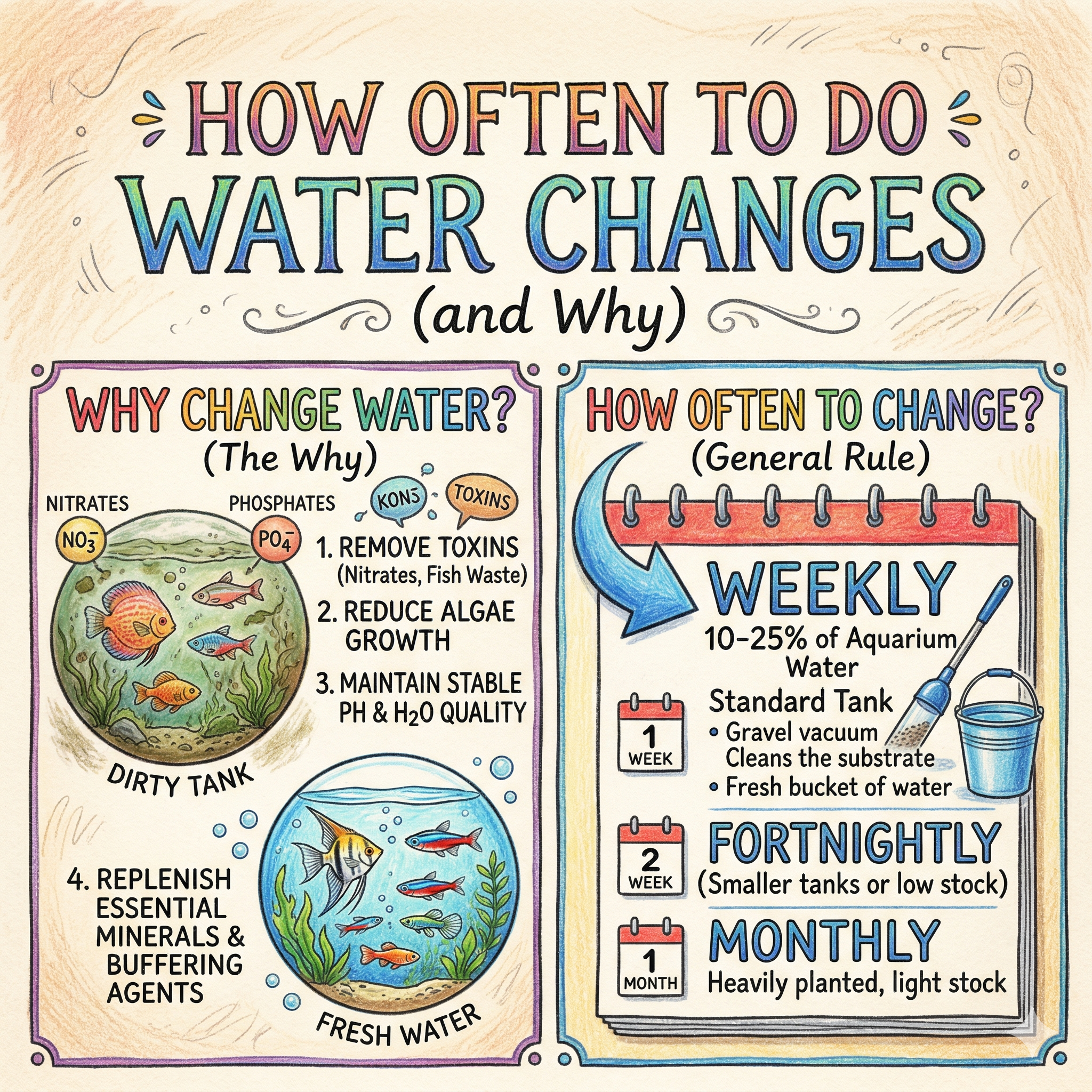
How Often to Do Water Changes (and Why)
Water changes are one of the simplest parts of aquarium care, and also one of the most misunderstood. Many beginners hear that water changes are essential, but they are not told how often to do them, how much water to remove, or why the routine matters so much. As a result, some people change too little water and let the tank slowly deteriorate. Others change too much at once, too often, and create unnecessary stress.
The right water-change schedule depends on the tank size, fish load, plant load, feeding habits, and how stable the system already is. But the core principle stays the same: water changes remove accumulating waste, help stabilize water chemistry, and keep the tank healthier over time than “topping off” ever can.
This guide explains why water changes matter, how often to do them, how much to change, and how to build a realistic schedule for home and small-office aquariums.
Water Changes at a Glance
| Tank Situation | Good Starting Schedule | Why It Works | Main Watch-Out |
|---|---|---|---|
| Typical beginner freshwater tank | Weekly | Keeps waste diluted and maintenance predictable | Skipping weeks lets nitrate and debris build |
| Lightly stocked or heavily planted stable tank | Every 1 to 2 weeks | Lower waste load may allow a slightly lighter schedule | Still needs real testing and observation |
| Small tank under 10 gallons | Weekly or more often if needed | Small tanks change faster and have less buffer | Waiting too long leads to quick instability |
| Heavily stocked or messy fish tank | Weekly, sometimes more | Waste builds faster | Underestimating the load causes nitrate creep |
| Cycling or problem tank | As needed based on water quality | Protects fish when water parameters are unstable | Do not treat this as the same as normal routine care |
Why Water Changes Matter
Water changes do more than make the tank look cleaner.
They help:
- dilute nitrate
- reduce dissolved waste
- remove excess organics and leftover buildup
- replenish minerals and buffering support depending on the water source
- keep pH and overall chemistry steadier over time
In a healthy aquarium, the filter processes waste biologically, but that does not mean waste disappears. Nitrate, dissolved organics, and general system load still accumulate. A water change is one of the main ways to reset the tank gently without tearing the system apart.
What a Water Change Does Not Do
Beginners sometimes expect water changes to solve every problem instantly. They help a lot, but they are not magic.
A water change does not:
- replace proper cycling
- fix overstocking by itself
- make poor filtration irrelevant
- substitute for correct feeding and maintenance habits
Water changes work best as part of a stable routine, not as emergency-only behavior.
The Best Starting Rule for Most Beginner Tanks
For most home freshwater aquariums, the best starting rule is simple:
- do a partial water change once per week
This works well because it is:
- easy to remember
- easy to build into a routine
- usually enough to prevent slow waste buildup in a normal beginner setup
If a beginner asks for the single safest default answer, weekly water changes are usually it.
How Much Water Should You Change?
For many freshwater aquariums, a partial change in the 10 to 25 percent range is a practical starting point.
The exact amount depends on:
- fish stocking
- tank size
- feeding level
- planting density
- nitrate buildup between changes
Why partial changes usually work best
They improve water quality without turning the tank into a full reset. Fish and beneficial bacteria do better with stable gradual maintenance than with rare extreme intervention.
Water Change Frequency by Tank Type
Small Tanks Under 10 Gallons
Small aquariums usually need more attention because they have less water volume to absorb mistakes.
Good beginner rule
- start with weekly changes
- increase frequency if nitrate rises quickly or the fish load is too high
These tanks are less forgiving, so consistency matters more.
Standard Beginner Freshwater Tanks
For many 10 to 29 gallon beginner freshwater aquariums:
- weekly partial water changes are a strong default
This is especially true for:
- community tanks
- betta tanks
- tanks with normal feeding and moderate stocking
Heavily Planted Tanks
A heavily planted, lightly stocked tank may sometimes tolerate slightly longer intervals. But “planted” does not automatically mean “low maintenance.”
If the tank stays stable and nitrate remains controlled, some owners stretch to every 1 to 2 weeks. For beginners, though, weekly is still often the easiest routine to trust.
Heavily Stocked or Messy Fish Tanks
Tanks with:
- cichlids
- larger fish
- messy eaters
- high feeding pressure
usually need stronger maintenance discipline. Weekly changes are still the baseline, and some setups need more.
Office Tanks
Office tanks benefit from predictability. A fixed weekly schedule is often easier to sustain than trying to judge the tank “by feel” between busy workdays.
Why Topping Off Is Not the Same as a Water Change
This is one of the biggest beginner misunderstandings.
When water evaporates, the water leaves but many dissolved substances do not. That means topping off:
- restores water level
- does not remove nitrate
- does not remove dissolved waste
- does not replace an actual maintenance cycle
Topping off is useful, but it is not a substitute for changing water.
How Water Changes Help Specific Problems
Nitrate Buildup
One of the clearest uses of water changes is nitrate control. If nitrate rises steadily between tests, the tank is telling you that maintenance, feeding, or stocking needs to be addressed.
Algae Pressure
Water changes do not “kill algae,” but they help reduce the conditions algae often feeds on by lowering dissolved waste and helping the tank stay cleaner overall.
pH and General Stability
Fresh conditioned water can help support more stable overall conditions than a tank left to drift for long periods without maintenance.
Fish Stress
Fish often do better in tanks where the water is consistently refreshed instead of left to decline until visible problems appear.
How to Do a Water Change Properly
Basic process
- Remove a partial amount of tank water
- Vacuum or siphon debris where appropriate
- Prepare fresh water with conditioner
- Match temperature reasonably well
- Refill slowly
- Confirm equipment restarts correctly if anything was turned off
The goal is calm, repeatable maintenance, not speed.
Common Beginner Water Change Mistakes
Waiting Too Long
Many new owners wait until the tank “looks dirty.” By then, water quality has often been sliding for a while.
Changing Too Much at Once Without a Reason
Massive changes can be stressful if done carelessly, especially if temperature or chemistry shifts sharply.
Using Unconditioned Tap Water
If the water source contains chlorine or chloramine, skipping conditioner can harm fish and beneficial bacteria.
Forgetting Temperature Match
Very cold or very hot replacement water can stress fish quickly.
Cleaning the Filter Too Aggressively During the Same Session
Routine maintenance is good, but stripping the tank and filter all at once can reduce stability. Gentle consistency is better than deep overcorrection.
How to Know if Your Schedule Is Working
Your schedule is probably working if:
- fish look active and stable
- nitrate stays under control
- algae is manageable rather than constantly exploding
- the tank does not smell dirty or look dull between changes
- maintenance feels sustainable instead of overwhelming
Your schedule may need adjustment if:
- nitrate climbs too fast
- algae returns aggressively
- fish show stress before the next scheduled change
- debris accumulates much faster than expected
This is why testing and observation matter alongside routine.
Weekly vs Fortnightly vs Monthly
Weekly
Best default for most beginner tanks.
Every 1 to 2 Weeks
Can be reasonable in:
- lightly stocked stable tanks
- some planted tanks
- systems with proven lower nitrate accumulation
Monthly
Possible in some very light, stable, mature tanks, but not a good default beginner rule. Many people use “monthly” too optimistically and end up with slow water-quality decline.
For most real beginner setups, weekly still wins.
Best Beginner Rule for Water Changes
If you want the simplest reliable answer:
- do a weekly partial water change
- keep the change moderate
- condition the new water
- use testing and observation to fine-tune later
This is easier and safer than waiting until something goes wrong.
Final Verdict
For most home aquariums, water changes should happen weekly unless the tank has clearly proven it can stay stable on a slightly lighter schedule. They matter because they dilute nitrate, remove dissolved waste, support cleaner conditions, and make the aquarium more forgiving over time.
The healthiest tanks are not usually the ones that get dramatic rescue maintenance. They are the ones that get calm, regular water changes before trouble builds.
Read Next
- Read the water parameters guide if you want to understand how nitrate, pH, and temperature relate to your change schedule.
- Read the beginner tank setup guide if you want a full maintenance routine that includes filtration, testing, and stocking discipline.
- Read the common algae problems guide if you are doing water changes but still seeing nuisance growth.
Affiliate note: this guide is naturally suited for future affiliate placements around siphons, buckets, conditioners, thermometers, and maintenance accessories, but the article should stay practical and routine-first rather than product-first.
PUBLIC_ADSENSE_GUIDE_INLINE_SLOT to enable this AdSense placement.
Keep moving from reading to action.
Use the related guides to go deeper, check the shop if you need matching accessories, or join the email list if you want future guides and product updates.
Get new guides, product updates, and practical aquarium planning notes by email without waiting to check back manually.
Use the contact page if you want direct help instead of general email updates.
Related Guides
Aquarium Filter Types Explained
Compare sponge, hang-on-back, canister, internal, and undergravel filters so you can choose the right aquarium filtration system for your tank size, fish, budget, and maintenance style.
Aquarium Lighting Guide
Learn how to choose aquarium lighting based on intensity, spectrum, timer control, plant needs, algae risk, and tank style so your setup looks good without becoming harder to maintain.
Complete Beginner Tank Setup Guide 2026
A complete step-by-step beginner aquarium setup guide covering tank size, equipment, cycling, stocking, and the most common mistakes that ruin first tanks.