Upgrading Your Aquarium: When and How to Scale Up
Most aquarium owners eventually hit a point where the original setup stops feeling like the right fit. The fish are healthy, but the tank feels cramped. The filter is working harder than it should. The aquascape has no room left to grow. Or the owner simply knows more than they did when they bought the first tank and wants to build something better. Upgrading is a normal part of the hobby, but it can go badly if it is treated like a simple transfer from one glass box to another.
The main mistake is assuming a bigger tank automatically fixes everything. A larger aquarium does give more room, more water volume, and often more stability, but it also creates new responsibilities. If you move fish too quickly, overclean the old filter media, or treat the new tank like a fresh blank start, you can create stress and instability right in the middle of what should have been a positive upgrade.
This guide explains how to know when it is time to scale up, how to plan the move, what to transfer from the old tank, and how to make the new aquarium feel like an upgrade instead of a reset.
Aquarium Upgrades at a Glance
| Situation | Good Upgrade Signal | Why It Matters | Main Watch-Out |
|---|---|---|---|
| Tank feels crowded | Fish are healthy but have little room or no layout flexibility | Growth and behavior need more space | Do not assume “still surviving” means the setup is ideal |
| Water quality is harder to maintain | Nitrate rises quickly or maintenance feels constant | Current system may be undersized for the load | Bigger tank helps only if filtration and stocking also improve |
| Fish choice has changed | You want species that need more room or different layout | New goals may no longer fit the old tank | Avoid forcing incompatible fish into the upgrade |
| You want a better display | You have outgrown the first beginner setup | A larger tank gives more room for equipment and aquascaping | Do not rush the move without a plan |
When Is It Time to Upgrade?
Not every tank needs to be upgraded just because a larger one looks appealing. A stable smaller tank that suits the fish and the owner’s routine can be a better long-term setup than a larger tank that becomes inconsistent.
Good reasons to scale up
- the fish have clearly outgrown the available swimming space
- stocking is too tight for long-term comfort
- the current tank is difficult to keep stable
- filtration and layout options are too limited
- you want a more appropriate setup for the species you already keep
- your experience has outgrown the original beginner design
Bad reasons to upgrade
- boredom with the tank without any real plan
- impulse livestock purchases that exceed the current system
- thinking bigger will fix poor maintenance habits automatically
An upgrade should solve a real limitation, not just shift the same problems into a larger box.
Common Signs the Tank Is Too Small
The fish do not have enough room to move naturally
If fish are always turning sharply, crowding each other, or using only small portions of the tank, the setup may be too limited.
Maintenance feels heavier every month
If nitrate rises quickly, algae returns fast, or waste builds faster than the routine can comfortably handle, the system may be too small for the fish load.
Equipment choices feel restricted
Smaller tanks often limit:
- filter options
- aquascaping space
- heating stability
- fish compatibility choices
Your livestock plan has changed
Many hobbyists start with a basic tank, then later realize they want a more planted layout, a stronger community setup, or fish that simply need more room.
Why a Bigger Tank Can Help
Larger aquariums usually provide:
- more stable water volume
- more room for filtration and aquascaping
- better fish behavior because space and sight lines improve
- more forgiving maintenance margins
- more flexibility for future stocking and plant growth
This is why a 20 gallon often feels easier than a cramped 5 gallon, and why a well-planned 40 gallon can feel calmer than an overloaded 10 gallon.
How to Choose the Right Upgrade Size
Do not upgrade from one compromised tank to another barely larger compromised tank.
Good upgrade mindset
Ask:
- What problem is the new tank solving?
- Does the new size actually fit the fish long term?
- Can I support the extra weight, cost, and maintenance?
- Does the room placement work better, not just look better?
Examples
- 5 gallon to 10 gallon: often a strong quality-of-life upgrade for bettas or beginner tanks
- 10 gallon to 20 gallon: one of the best beginner-to-growth upgrades
- 20 gallon to 40 gallon: useful when community stocking, aquascaping, or filtration needs are expanding
Choose the upgrade that creates real breathing room, not just slightly more glass.
What Should Transfer to the New Tank?
One of the most important parts of an upgrade is preserving biological stability.
Usually worth transferring
- established filter media
- some decor and hardscape
- some substrate, if clean and appropriate
- healthy plants
- the fish themselves, after the new setup is ready
Why filter media matters so much
Established filter media carries beneficial bacteria. If you throw that away and treat the larger tank like an entirely fresh setup, you lose one of the main things helping the transition stay safe.
What Not to Do During an Upgrade
Do not deep-clean everything at once
If you strip the old tank, replace all media, rinse everything aggressively, and move the fish on the same day, you risk destabilizing the entire system.
Do not treat the larger tank as “instantly perfect”
A bigger tank is still a system that needs to settle. The move can be smoother than a true new setup, but it still needs careful observation.
Do not add lots of new fish during the same move
Upgrade day is not the best day to expand the stock list dramatically.
Step-by-Step Upgrade Plan
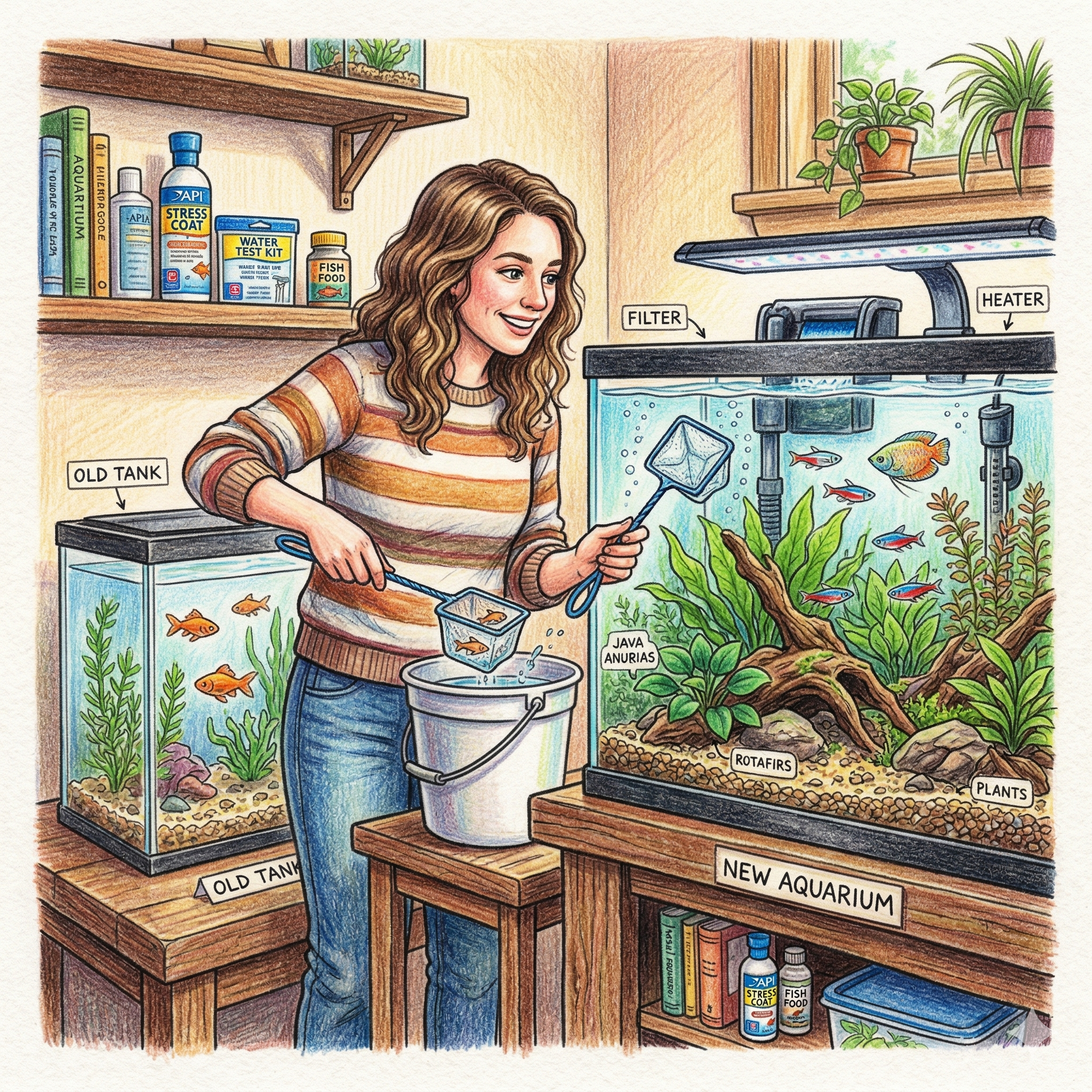
1. Set up the new tank fully
Before moving any fish:
- place the tank on the final stand
- add substrate and hardscape
- install filter, heater, and light
- fill and condition the water
- make sure temperature and equipment are stable
2. Transfer established filtration support
Move over:
- mature filter media
- some old hardscape if appropriate
- healthy plants and decor
This helps the new tank behave more like a transition and less like a raw new cycle.
3. Move fish calmly
Use a normal transfer method:
- catch fish gently
- avoid extended exposure to temperature swings
- keep the process calm and deliberate
4. Watch the tank closely afterward
In the days after the move, pay attention to:
- fish breathing and behavior
- temperature
- filter performance
- ammonia and nitrite
- nitrate trend
5. Delay extra stocking
Let the system settle before making it more complicated.
Should You Reuse Old Water?
This question comes up often.
The practical answer
Old water can help reduce immediate change in some situations, but the real biological value is usually in the filter media and established surfaces, not the water alone.
That means:
- moving some old water is fine if it helps the transition
- preserving mature filter media matters more
- clean, conditioned new water is still necessary
Upgrading Without Stressing the Fish
Fish usually respond best when the move is:
- planned
- calm
- temperature-aware
- not overloaded with simultaneous changes
Stress rises when:
- the tank chemistry swings sharply
- the move takes too long
- the new layout removes all cover at once
- new fish are added immediately
The cleaner the plan, the easier the transition.
Best Upgrade Paths for Common Tank Types
Betta tank upgrade
Good path:
- 5 gallon to 10 gallon
Why:
- more stable water
- more layout flexibility
- easier gentle filtration choices
Beginner community upgrade
Good path:
- 10 gallon to 20 gallon long or larger
Why:
- better schooling room
- better bottom-fish compatibility
- easier maintenance rhythm
Display upgrade
Good path:
- 20 gallon to 40 gallon or larger
Why:
- more aquascaping space
- better visual impact
- room for stronger filtration and cleaner stocking logic
Common Upgrade Mistakes
Upgrading Too Late
Waiting until the fish are visibly stressed or the tank is chronically failing makes the move harder than it needs to be.
Buying the New Tank Without a Full Equipment Plan
A bigger aquarium often needs:
- stronger filtration
- different heater sizing
- a more stable stand
- a more realistic maintenance plan
Throwing Away Mature Filter Media
This is one of the easiest ways to turn a smooth upgrade into a water-quality problem.
Turning the Upgrade Into a Total Redesign Plus Restock
Too many changes at once create avoidable instability.
Final Verdict
The right time to upgrade an aquarium is when the current tank no longer gives the fish, the equipment, or the owner enough room to succeed comfortably. A larger tank can improve stability, layout flexibility, and fish behavior, but only if the move is handled with a real transition plan. The smartest upgrade keeps the mature biological support, moves fish calmly, and avoids turning one good system into a rushed reset.
The best aquarium upgrades do not feel dramatic after the move. They feel easier.
Read Next
- Read the guide on choosing the right aquarium if you are still deciding what size the upgrade should be.
- Read the budget setup guide if cost is shaping how far you can scale up right now.
- Read the water parameters guide if you want to monitor the new tank closely after the transfer.
Affiliate note: this guide is naturally suited for future affiliate placements around larger tanks, stronger filters, transfer buckets, conditioners, thermometers, and layout accessories, but the article should stay transition-first rather than gear-first.
PUBLIC_ADSENSE_GUIDE_INLINE_SLOT to enable this AdSense placement.
Keep moving from reading to action.
Use the related guides to go deeper, check the shop if you need matching accessories, or join the email list if you want future guides and product updates.
Get new guides, product updates, and practical aquarium planning notes by email without waiting to check back manually.
Use the contact page if you want direct help instead of general email updates.
Related Guides
Aquarium Filter Types Explained
Compare sponge, hang-on-back, canister, internal, and undergravel filters so you can choose the right aquarium filtration system for your tank size, fish, budget, and maintenance style.
Aquarium Lighting Guide
Learn how to choose aquarium lighting based on intensity, spectrum, timer control, plant needs, algae risk, and tank style so your setup looks good without becoming harder to maintain.
Complete Beginner Tank Setup Guide 2026
A complete step-by-step beginner aquarium setup guide covering tank size, equipment, cycling, stocking, and the most common mistakes that ruin first tanks.